
Firstly, TeraFab is not going to be launched in 2026; it is a long-term plan that could span up to a decade in execution. Tesla will continue to patronize its existing foundries, which it has partnered with, even before the conception of TeraFab. However, the concept of TeraFab really raises a concern about how the likes of Intel and TSMC would hold up when it finally becomes a reality.
Elon Musk, Tesla’s CEO, already believes that the only way for the company to remain a leader in its industry is to foster a foundry that meets its visionary goal for the future. How would all these unfold? In today’s article, we’ll be looking into Tesla’s proposed TeraFab foundry, how it’d power the next generation of Tesla’s AI chips, and whether or not it would be a successful concept.
TeraFab and Tesla Chips: What’s there to Know?
Tesla’s autonomous vehicles and EVs are powered by the company’s own chips, which are designed by the company’s in-house team, but built in partnered foundries owned by Samsung and TSMC. Many Tesla models are powered by the Full Self-Driving (FSD) computer system, which is built using the company’s in-house AI chips (“AI4,” “AI5,” etc.).
At the moment, Tesla intends to dual-source its AI chip manufacturing: Samsung’s new Texas fab and TSMC’s Arizona fab will each make slightly different versions of Tesla’s chips. However, CEO Elon Musk also noted that there’s an ongoing proposal to work with Intel for semiconductor manufacturing for Tesla.
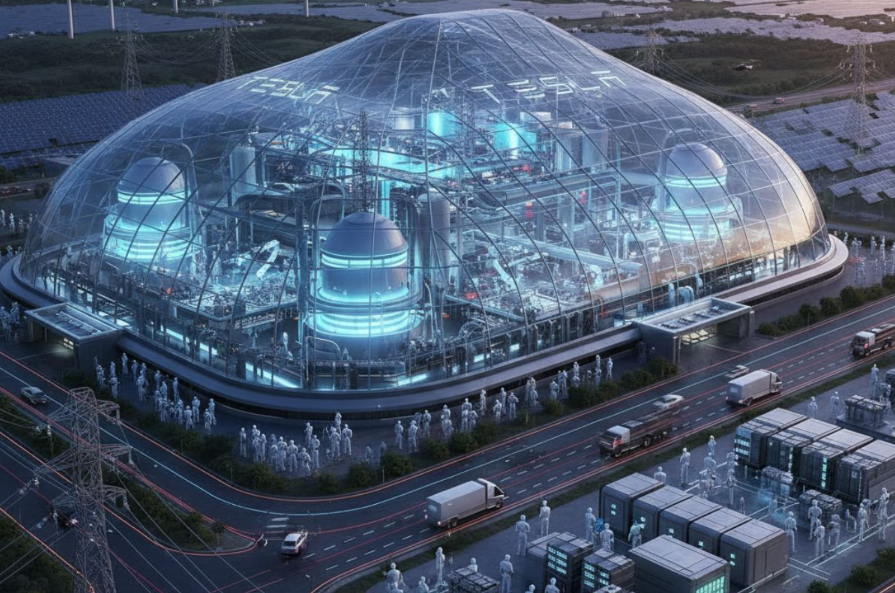
But then, amidst all of these, Elon, at Tesla’s 2025 shareholder meeting, submitted that continual dependence on external foundries might not supply enough advanced Tesla AI chips as much as the company would need for its autonomous vehicles and robots going forwars, and so he proposed a Tesla-owned foundry, dubbed “TeraFab,” a foundry that would satisfy its future AI-chip needs.
According to descriptions, TeraFab would be a “gigantic chip fab,” capable of handling up to 100,000 wafer starts monthly, initially. As it stands, Tesla has no fabs of its own (yet). It currently relies on TSMC and Samsung to produce its custom Tesla chips for different needs. The TeraFab idea, proposed by Elon Musk, did sit well with Tesla shareholders, and so the company might just move to make it a reality.
The actual aim of TeraFab is to allow Tesla to own and control every layer of its AI hardware “from chip design to production,” to ensure a steady chip supply for its future robotics and autonomous systems. TeraFab is more like a next-gen project and not an urgent project to be completed within the shortest time possible.
Will TeraFab Rival Intel and TSMC in AI Chips Production?
Well, it may, it may not. We can’t be so sure about that, at least not now. The giant semiconductor fabrication plant dedicated to Tesla’s chips would be finished to perfection and equipped with the finest materials and production machines, but until it launches and produces its first set of semiconductors, we can’t be sure whether it’d be a rival to Intel and TSMC, both of which have made a name for themselves in the micro-chip niche.
However, Tesla expects that its upcoming TeraFab plant would produce 1.2 million 12-inch wafers per year initially, with the potential of rising to approx 12 million per year at full scale.
Anticipated Advantages of TeraFab Include:
- Eliminate Supply Bottlenecks: By producing chips internally, Tesla could avoid supply bottlenecks. CEO Elon Musk believes that only by making chips internally, Tesla can guarantee enough units for the millions of cars and robots it has proposed for the next-gen market.
- Full Autonomy: An in-house fab means Tesla can tailor processes exactly to its chip designs and AI workload. This close alignment of design and manufacturing could yield efficiency gains.
- Cost and Power Efficiency: Musk claims Tesla’s AI chip will be power-efficient and inexpensive, roughly 1/3 the power draw of Nvidia’s top chip and only 10% of the production cost.
- Supply-Chain Control: Tesla is a big company, and it’s only best that it has total control of its supply chain. A dedicated Tesla fab would reduce dependence on third-party foundries and supply chain inefficiencies.
TeraFab will become the compute backbone of Tesla’s AI ambitions: Autonomous EVs and humanoid robots (Optimus). In addition to the company’s neural software development, TeraFab would allow Tesla to build and optimize the chips on which their neural software would run.
Tesla’s TeraFab vs. Intel and TSMC Foundries
| Factor | Tesla (TeraFab) | Intel | TSMC |
| Wafer output (12″ eq.) | Approx. 1.2M/year initially; potential ~12M if scaled 10× | ~1–2M/year (2024) | ~17M/year (2024) |
| Foundry market share | Would be for Tesla’s internal use only | <5% (still nascent) | ~70% (Q2 2025 record) |
| Primary focus | Custom AI inference chips for Tesla’s vehicles/robots | x86 CPUs and AI accelerators (servers/PCs) | Leading-edge contract foundry (3nm/2nm) for global chipmakers |
| Tech specialization | “Integer-first” chips optimized for Tesla’s neural nets | Monolithic CPUs/GPUs, Gate-All-Around nodes | FinFET/GAAFET processes at newest nodes; advanced packaging (CoWoS, SoIC) |
TSMC is currently the go-to partner for most AI chip designers, including Nvidia, AMD, and Apple. It’d take a long time for them to be overthrown in this niche, especially since the TeraFab proposition isn’t on commercialization.
Conclusion
Tesla’s TeraFab is an ambitious project that’s yet to be kick-started. Theoretically, it looks like it’d disrupt the AI chip production market, rivaling Intel and TSMC, but so far, practically, TSMC is still the market leader, and Intel’s foundry is nascent.
In 2026, TeraFab won’t be live yet; Samsung and TSMC will continue to handle Tesla’s microchip manufacturing through partnerships. But it’s going to be really interesting when Tesla pulls this TeraFab project in the coming years.