
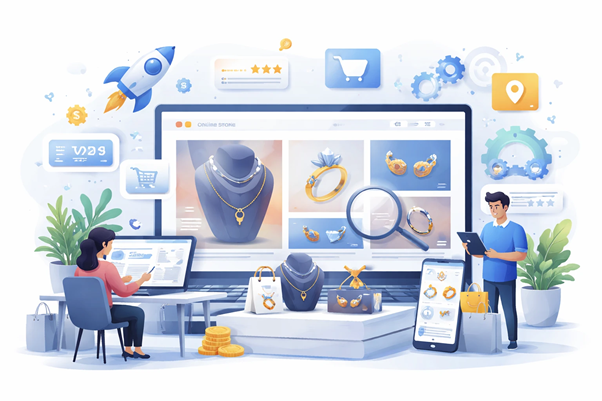
Nowadays, more and more companies are beginning to invest in jewelry website development due to the benefits these solutions provide for e-commerce store owners. However, speed is the main concern in this area. Customers expect not only beautiful products but also fast-loading websites, smooth mobile experiences, personalized interactions, and absolute trust in the brand.
That is why with the right strategy, technology, and design, jewelry businesses can build a strong online presence, increase sales, and effectively compete in a crowded eCommerce landscape.
Let’s find out what you can get by implementing these solutions, discover which features drive conversions, and understand how jewelry ecommerce development can help small retailers stand out and thrive.
The Benefits of Jewelry eCommerce Development
Today, customers do research before making a purchase. They compare prices, read reviews, explore brand stories, and expect a smooth digital experience. As a result, small retailers risk becoming invisible at critical stages of the buying journey without a strong online presence.
Besides, jewelry has special characteristics compared to many other eCommerce products, as it carries emotional value, long-term significance, and higher price points. Customers want assurance regarding materials, authenticity, warranties, and return policies. A professionally designed website conveys credibility and helps reduce hesitation, which directly impacts conversion rates.
It is also worth mentioning that the jewelry e-commerce market is highly competitive, with large brands and marketplaces dominating paid advertising and search results. It is no surprise that this makes it challenging for small retailers to compete based solely on visibility. However, thanks to smart development, jewelry website allows brands to differentiate through storytelling, niche positioning, superior user experience, and personalized customer journeys.
Key Features That Make a Jewelry Website Convert Better

1. High-quality Images
Jewelry customers rely on images. However, poorly optimized media can negatively affect performance. High-converting jewelry websites balance aesthetics and speed by utilizing optimized high-resolution images, zoom and 360-degree views, consistent lighting, and lightweight videos or animations that highlight craftsmanship and detail.
2. Mobile-first design
Mobile commerce continues to dominate online shopping behavior. Jewelry websites must be designed with mobile users as the primary audience. This includes intuitive one-handed navigation, touch-friendly filters and buttons, fast mobile checkout flows, and seamless transitions between browsing and purchasing.
3. Clear product descriptions
Uncertainty is one of the main barriers to conversion in jewelry ecommerce. Effective product pages provide detailed information, accurate sizing guides with visuals, care and warranty details, transparent pricing, and clear delivery timelines. Greater clarity reduces hesitation and lowers cart abandonment rates.
4. Trust signals
Trust is a decisive factor in high-consideration purchases. Strong trust elements include verified customer reviews, secure payment and SSL indicators, transparent return and refund policies, and an authentic brand story supported by real people behind the brand. Together, these elements build confidence and credibility.
5. Personalization
Personalization is increasingly essential for improving engagement and average order value. You can consider using product recommendations based on browsing behavior, recently viewed items, gift suggestions by occasion or price range, and location-based delivery. You should remember that even simple personalization can significantly improve average order value.
6. Fast, intuitive, and secure checkout
A well-designed checkout process minimizes friction and supports conversion. Best practices include guest checkout options, multiple secure payment methods, reduced form fields, and clear progress indicators.
How Jewelry Website Development Helps Small Retailers Compete with Big Brands

1. Competing on experience rather than scale
Large brands often lack agility and personalization. Small retailers can turn this into an advantage by offering curated collections, tailored messaging for specific customer segments, and faster responses to trends and customer feedback.
2. SEO-focused development
A well-built website supports sustainable organic growth through clean site architecture, optimized product and category pages, fast loading speeds, Core Web Vitals compliance, and structured data that enhances search visibility.
3. Clear brand positioning and niche authority
Successful small jewelry brands typically focus on a defined niche, such as ethical sourcing, handcrafted pieces, minimalist design, or personalized gifting. You should reinforce this positioning through consistent visual identity, content aligned with niche keywords, and clear communication of craftsmanship and brand values.
4. Data-driven optimization
Modern ecommerce platforms provide detailed insights into customer behavior. A strategically developed website enables retailers to analyze user journeys, identify drop-off points, evaluate product performance, test layouts and messaging, and continuously optimize based on real user data.
5. Scalability without unnecessary complexity
This includes modular design, flexible architecture, seamless integration with marketing and fulfillment tools, and the ability to expand functionality as the business grows, without costly rebuilds.
Final Thoughts
In summary, jewelry website development in 2026 goes beyond simply launching an online store. It focuses on creating a high-performing digital experience that builds trust, communicates brand value, and supports long-term growth.
By prioritizing performance, usability, personalization, and clear brand differentiation, small jewelry retailers can increase online revenue, strengthen customer relationships, and compete effectively in today’s e-commerce environment.