
 In development, teams often face a common challenge: translating data types such as design files, documents, and images into working, functional code. The process of manually converting these inputs into production-ready code is not only time-consuming but also prone to errors, leading to delays and frustration. As projects grow in scale, keeping everything consistent across multiple files and platforms becomes increasingly complex.
Kie.ai’s Codex API solves this problem by enabling multi-modal input, allowing developers to integrate text, images, and design files seamlessly into the development workflow. By automating UI code generation, optimizing interfaces, and ensuring consistency across projects, the API reduces the time spent on manual coding and streamlines the design-to-code process.
This ultimately improves collaboration, boosts productivity, and accelerates project timelines, making it easier for teams to focus on what truly matters: building innovative, functional applications.
What is Multi‑Modal Input?
Multi‑modal input refers to a model’s ability to understand and work with different types of data together — not just plain text, but also images, files, and structured information — in a single request. Rather than treating each input type separately, a multi‑modal system can combine and interpret them collaboratively, allowing developers to feed complex inputs and get unified, meaningful outputs.
In the context of Kie.ai’s GPT‑5.4 Codex API, multi‑modal input means you can submit a variety of materials — such as design files, screenshots, documentation, or even mixed text and visual assets — and the API will process all of these together to generate or modify code based on the content it receives. This capability goes beyond simple text‑only prompts, enabling the API to produce richer results from richer inputs.
For example, instead of manually translating an image or a visual draft into text descriptions before generating code, developers can provide the visual input directly alongside text. The API then interprets the visual and textual information in tandem, reducing the need for preliminary conversions and offering a more efficient, integrated workflow. This approach streamlines tasks that traditionally required multiple tools or steps, making it easier to automate complex development work that spans different input formats.
Combining Codex’s Programming Power with GPT’s Reasoning Capabilities
Kie.ai’s ChatGPT Codex API merges the programming power of Codex with the reasoning capabilities of GPT, creating a unified model that can both develop and analyze code without the need for separate tools.
This combination allows developers to seamlessly handle a range of tasks from coding to debugging, reducing the complexity of switching between different models. Whether you’re building new features, optimizing existing code, or analyzing complex codebases, the Codex-GPT hybrid model enables a more efficient and cohesive development process, ultimately improving workflow and productivity.
GPT-5.4 Codex API Supports Production-Grade Code Generation, Multi-File Modifications, and Complex Refactoring
The GPT-5.4 Codex API offers robust support for production-grade code generation, making it capable of handling complex, real-world development tasks. Beyond just writing basic code, it can modify multiple files at once and perform complex refactoring across large codebases.
This ensures that even the most intricate code adjustments are made accurately and consistently. Developers can leverage this feature to directly contribute to project development, reducing the need for repetitive code revisions and speeding up the development cycle. Its ability to manage large projects effectively makes it an ideal choice for teams working on enterprise-level applications or multi-page web projects.
Significant Improvement in Front-End Development: UI Code Generation and Page Logic Handling
The GPT-5.4 Codex API excels in front-end development, significantly improving the process of generating UI code and handling page logic. Whether you’re working with HTML, CSS, or JavaScript, the API can translate design files or visual assets directly into clean, functional code, eliminating the need for manual coding.
In addition to generating the UI structure, it can also handle interactivity, such as forms, buttons, and navigation, ensuring a smooth user experience across various elements. This boosts the efficiency of front-end development teams, helping them focus on higher-level tasks, while the API takes care of the routine, code-heavy work.
Multi-Modal Input for Streamlined Development: Integrating Text, Images, and Files into Code Generation
The multi-modal input feature of GPT-5.4 Codex API is a powerful tool that allows developers to integrate text, images, and files directly into the development workflow. By combining these various types of inputs, the API can generate or modify code with unprecedented efficiency and accuracy.
For instance, designers can upload design drafts, screenshots, or even detailed documentation, and the API will process them alongside textual instructions to generate the corresponding UI code.
This significantly speeds up the development process, as it eliminates the need for manual interpretation or translation of designs into code, improving both productivity and collaboration across teams.
Why Choose Kie.ai’s GPT-5.4 Codex API for Development Projects?
Here are some of the big reasons to opt for Kie.ai GPT 5.4 Codex API for your web and application development projects:
Affordable Pricing for Developers and Teams
One of the standout advantages of using Kie.ai’s GPT-5.4 Codex API is its cost-effective pricing. Developers and teams can access advanced API without exceeding their budgets. The pricing structure is significantly more affordable than the official rates, making it accessible to startups, small businesses, and large enterprises alike.
For example, input for 1 million tokens costs just $0.70, while output is priced at $5.60, which is approximately 60% cheaper than standard rates. Additionally, Kie.ai offers high-volume top-ups that provide a +10% bonus, effectively lowering costs even further to about $0.636 for input and $5.09 for output per 1 million tokens.
This affordable pricing ensures that businesses of all sizes can integrate advanced AI capabilities into their development projects without compromising on quality or scalability.
Comprehensive API Documentation for Easy Integration
Kie.ai provides detailed and comprehensive documentation for developers, ensuring a smooth and hassle-free integration of GPT-5.4 Codex API into your projects. The clear and structured guides, best practices, and usage examples help both beginners and experienced developers understand how to use the API effectively.
Whether you’re automating UI code generation, handling multi-modal inputs, or managing large-scale codebases, the documentation makes it easy to get started and troubleshoot along the way. This support helps developers save time, avoid errors, and ensure optimal use of the API’s features.
Enhanced API Key Management with Whitelisting and Usage Restrictions
Security and access control are paramount for businesses using an API. Kie.ai offers API key whitelisting to ensure that only authorized users can access the GPT-5.4 Codex API. This adds an additional layer of security, especially for enterprise-level applications where sensitive data and proprietary code are involved.
Furthermore, businesses can set usage limits for API calls, helping to avoid overages and manage costs more effectively. These features give developers and teams more control over their API usage, ensuring secure and efficient project development.
Detailed API Usage Logs for Transparency and Optimization
Kie.ai’s platform also provides API usage logs, which give developers full transparency into how the API is being utilized. These logs track metrics such as token consumption, response times, and usage patterns, allowing teams to monitor performance and optimize their workflows.
By reviewing these logs, developers can identify areas where improvements can be made, whether it’s optimizing the way requests are structured or ensuring that the API is being used efficiently across different stages of development. This level of insight allows teams to make informed decisions about resource allocation and improve overall project efficiency.
How to Leverage Multi-Modal Input with Kie.ai’s GPT-5.4 Codex API
Step 1: Set Up Your Kie.ai Account and Retrieve Your API Key
The first step in using Kie.ai’s GPT-5.4 Codex API is to create an account on the Kie.ai platform. After registration, you’ll receive a unique API key, which is essential for authenticating your requests to the API.
This key ensures secure communication between your system and the API. Once you have the key, configure your development environment to securely store and use it for all API interactions, enabling seamless integration into your projects.
Step 2: Prepare and Submit Multi-Modal Inputs
After setting up your API key, you can begin preparing the various types of input that you’d like to send to the GPT-5.4 Codex API. The multi-modal input capability allows you to combine text, images, and files into a single request, providing a richer, more diverse set of information for the model to process.
For example, you might include design files, screenshots, or textual descriptions of your project’s functionality. Structuring these inputs clearly ensures the API can interpret them correctly and generate the appropriate responses based on the combined information.
Step 3: Choose Your Response Behavior and Tool Options
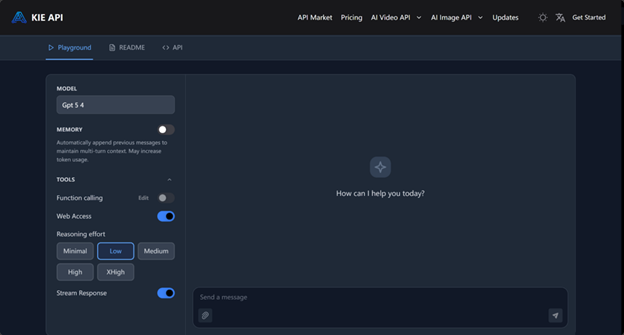
Once the multi-modal input is prepared, the next step is configuring how you want the GPT-5.4 Codex API to respond. You can choose whether you’d like the response to stream in real time as the model processes the input or return the complete result once it’s fully processed.
Additionally, you have the option to adjust the model’s reasoning effort to balance between speed and depth of analysis, depending on the complexity of your request. You can also integrate external tools, such as web search or custom functions, to enhance the generated response, further streamlining your development workflow.
Step 4: Review and Refine the Output
After the API processes the multi-modal input, it will return the generated output, which could include UI code, logic modifications, or other necessary adjustments based on the input data. At this stage, you’ll need to review the output to ensure it meets your project’s requirements.
If adjustments are needed, you can refine the output by providing additional input or tweaking the initial request. This flexibility allows for quick iterations, ensuring that the generated code aligns with your objectives and the project’s goals.
Step 5: Integrate the Output Into Your Development Workflow
Once you’re satisfied with the output, you can integrate the generated UI code and modifications into your ongoing development work. The API ensures that the design intent is maintained while also fulfilling the functional requirements of the project.
Since multi-modal input helps ensure consistency between visual and functional aspects, the generated code is more accurate, reducing the need for manual adjustments and improving overall development efficiency.
Step 6: Continuously Optimize and Automate
As your project evolves, continue to leverage multi-modal input to automate further code generation and optimization. Whether you need to make design updates, modify functionality, or scale your project, the GPT-5.4 Codex API makes it easy to iterate on your codebase quickly.
The multi-modal input ensures that updates across text, images, and design files are processed efficiently, reducing errors and improving overall collaboration between team members. By integrating Kie.ai’s GPT-5.4 Codex API into your workflow, you can significantly improve your development speed, consistency, and productivity.
Improving Development Efficiency with Multi-Modal Input
Kie.ai’s GPT-5.4 Codex API offers a powerful solution for development teams by enabling seamless integration of multi-modal inputs, such as text, images, and files, into the design-to-code process.
This functionality streamlines workflows, improves the accuracy of code generation, and accelerates project timelines. With the ability to generate production-quality UI code, automate repetitive tasks, and handle large-scale projects, the GPT-5.4 Codex API helps teams work smarter, not harder.
By providing efficient ways to manage both the visual and functional aspects of development, it allows teams to focus on innovation rather than manual coding, significantly improving productivity and collaboration.