
Evaluating payment and billing software can feel like comparing apples to slightly different apples. Most platforms handle recurring invoices, store cards, and email customers when a renewal fails. The details, however, shape revenue growth and operational workload in ways that only become obvious after launch.
PaymentKit was designed for companies that want billing flexibility without committing to a single payment processor. Below, we review five design choices that separate PaymentKit from specialized subscription tools and processor-bound SDKs.
1. Billing Logic Lives Outside the Processor
Legacy billing tools often embed pricing rules, prorations, seat counts, and usage tiers inside one processor’s API. That shortcut speeds up an MVP, but it also hard-codes a business model to a gateway. PaymentKit takes the opposite path. Pricing catalogs, subscription lifecycles, discounts, coupons, and tax settings all sit in PaymentKit’s own data model: paymentkit.com. The platform then calls whichever processor you have configured for a given transaction.
Because billing rules are decoupled, Finance can test new plans without engineering migrations, and Legal can negotiate lower interchange fees with another acquirer without rewriting billing code. For organizations operating in multiple regions, this division also avoids duplicating pricing catalogs for each local processor. One catalog rules them all, reducing reconciliation work and the surface area for billing bugs.
2. Multi-Processor Routing Is Native, Not an Add-On
Many vendors promote “one-click” access to extra processors, but those connections often run through a single origin provider, creating a hidden dependency. PaymentKit instead lets you connect to each processor directly, using its own API keys and settlement accounts. Routing rules, such as geography, currency, card brand, or cost threshold, are configured in the dashboard or via API.
A practical example: A SaaS tool serving customers in the EU, the US, and Brazil uses Adyen, Stripe, and EBANX. PaymentKit evaluates every authorization request in real time. Cards issued in Latin America go to EBANX, European Visa cards to Adyen, and everything else to Stripe.
If a rule sends a payment to a processor that is temporarily down, PaymentKit automatically fails over to the next eligible processor in the routing tree, logs the event, and exposes it in webhooks so that your BI stack captures the incident.
3. Tokens Are Processor-Agnostic and Portable
Card and wallet tokens are often locked inside the vault that created them. Migrating away means asking every customer to re-enter their payment data – a conversion risk nobody enjoys. PaymentKit operates an independent vault that supports PCI DSS Level 1 storage, network tokens, Apple Pay, and Google Pay tokens. The token stays the same even if you later swap the underlying processor.
Practically, the vault exposes a single token ID per payment instrument. When PaymentKit routes a transaction to Processor A, it converts that internal token to the format Processor A expects. If a rule later picks Processor B, the platform performs the same mapping in the background. Developers never see the mapping table; customers never receive an unnecessary “update your card” email.
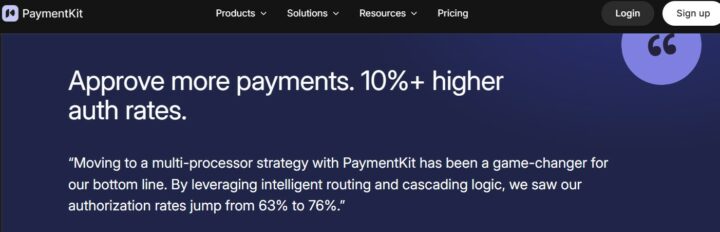
Network tokenization also improves authorization rates by using tokens automatically refreshed by card networks. Visa and Mastercard report average approval lifts when network tokens are used instead of raw PANs, and fraud is reduced by almost 90%. PaymentKit integrates those updates into recurring workflows without extra code.
4. Payment Recovery Is Embedded in the Core Workflow
The traditional dunning process is usually added on after the first batch of non-renewals is reported in financial statements. PaymentKit makes recovery a first-class citizen.
If the authorization is denied, the platform retries adaptively every day at a time that is optimized for the issuer’s behavior, the day of the month, and the network throttling limits. It then sends branded e-mail or in-app prompts to update the payment method with a secure link.
Because the retry schedule is aware of routing rules, a second attempt can automatically cascade to another processor with higher acceptance rates for the given BIN range. All events – decline reason, retry result, dunning email opened – land in a unified timeline attached to the subscription object. That context allows customer success teams to intervene manually when high-value accounts show warning signs.
5. Revenue Analytics Span All Connected Processors
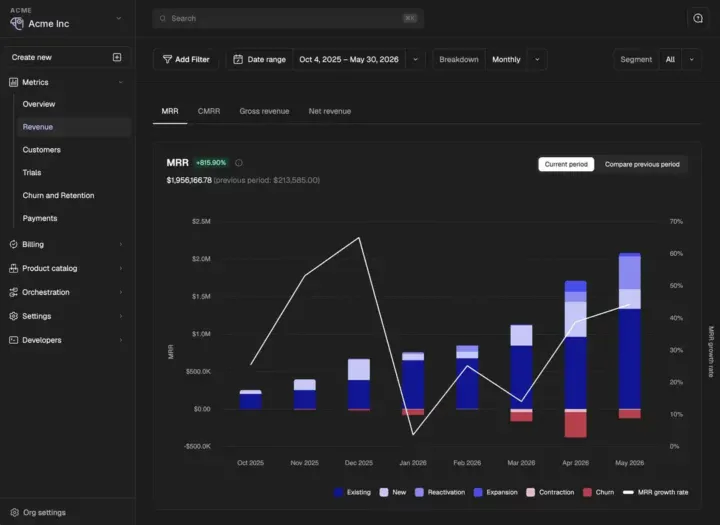
Multiple processors typically require downloading all the CSV files from each dashboard and merging them in a spreadsheet. PaymentKit makes that process easy by normalizing transaction, dispute, refund, and fee information into a single schema. Within the UI and API endpoints, there are metrics, such as monthly recurring revenue, net revenue retention, and chargeback rate.
The data model has processor identifiers, so you can use the filter to identify regions with performance issues. Finance teams love the ability to record the fees and FX spreads at the transaction level, giving them the ability to perform real margin analysis, not approximation margin analysis based on blended rates. The same normalized events can be streamed into a warehouse by a managed webhook to maintain internal reports.
When the analytics layer runs on consolidated data, strategic questions such as “Should we shift more volume to a lower-cost acquirer? Is a new pricing plan cannibalizing upgrades?” move from opinion to measurable KPI tracking. That speeds up experimentation cycles and shortens the path to better unit economics.
Putting It All Together
PaymentKit’s core difference is architectural: billing configuration, payment routing, token storage, recovery logic, and analytics all live in one platform but remain processor-agnostic. Businesses gain the freedom to negotiate processing contracts, expand into new markets, or adopt emerging payment methods without rebuilding billing foundations.
For SaaS companies at Series A or beyond, the alternative is often a patchwork of a subscription engine, a gateway SDK, a vault service, and a BI pipeline held together by custom scripts. While each component can perform its own job well, they may all fall short in providing revenue teams with the numbers they need in time or in the event of a processor outage.
PaymentKit is a single solution that focuses on flexibility and data consistency, which becomes even more important as volume and geographic scope increase.