
In this era of A.I. dependency, the second-best thing to know after mastering how to build apps and websites using A.I. (vibe coding) and building A.I. agents is where to host the AI-based developments (agents, apps, or websites) you’ve just vibe coded; hence, this exposé on the best managed AI hosting services for businesses.
Most AI aficionados who run AI agents often have the files running on localhost; while that works, it is very limiting when you want to get more from your AI agent. For example, if you need your AI agent to start running schedules, auto-recover from failures, and connect to external APIs, you sure know you need to get it on a managed host to get those done, and that’s what brings us to this piece.
The 10 Best Managed AI Agent Hosting Services for You
Unlike the traditional hosting you do for your vibecoded websites and apps, or traditional CMSes like WordPress and Shopify, Agentic AI hosting takes a different approach – it’s often “managed.” If you’ve used managed WordPress hosting before, you could understand this better.
AI agents need persistent execution, API connectivity, cron-like scheduling, observability, and memory management; a static site host won’t effectively handle these actions. So, here, we have gathered some of the very best AI agent hosting services you should choose from; whether it’s for your OpenClaw AI agents, Hermes AI agents, or any other AI agent, these platforms would handle them effectively.
1. Cloudways (visit) => Best for OpenClaw and Hermes
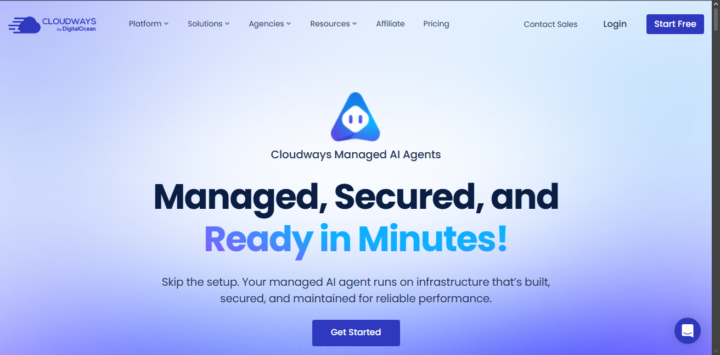
Yeah, Cloudways remains one of the best managed hosting service providers across categories, and for your AI agents, they’re still a good choice, especially when you’re running OpenClaw or Hermes AI agents. You can deploy both OpenClaw and Hermes agents directly from your existing Cloudways dashboard, bring your own LLM key from OpenAI, Anthropic, or Google, and Cloudways would provide the provisioning, security patching, and the daily operational upkeep that local hosts can’t handle effectively.
The pricing is fair and clear; you’re billed based on the workload of your instances. If you’re running an agent for workflows, the Scout plan at $4.99/month is a great deal; it offers 1vCPU, 2GB RAM, 2 TB bandwidth, and 50GB storage. Of course, for a serious agent with heavy workflows, you should consider the Operator or Squad plans, which give you more resource allocations. Interestingly, you can move between tiers anytime without rebuilding your setup.
PROs:
- Purpose-built platform for both OpenClaw and Hermes
- Automated daily backups, restore checkpoints, managed SSL, and firewall included
- Dedicated instance per customer with SSH access and log visibility for developers who want it
- Backed by DigitalOcean-powered infrastructure
CONs:
- LLM token costs are entirely separate and billed by your model provider, not Cloudways
- The jump from Scout ($9.99/mo) to Operator ($19.99/mo) feels steep if you only need a little more headroom
2. MyClaw (visit) => Best Premium Dedicated Hosting for OpenClaw and Hermes
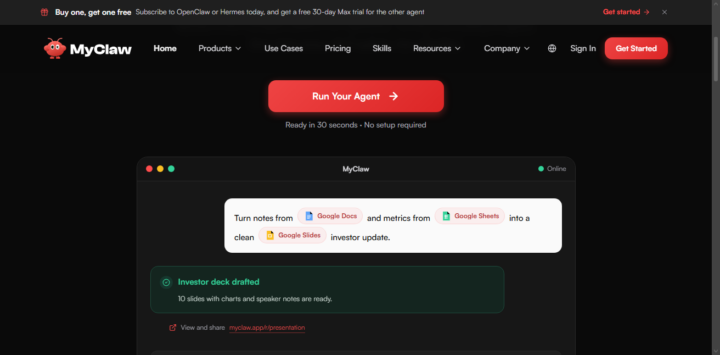
Let’s say this one’s a more premium alternative to Cloudways. Every MyClaw plan ships with a genuinely dedicated instance rather than a shared container, full root access if you want it, automatic updates, and daily backups, all wrapped in a private, encrypted environment. It supports both OpenClaw and Hermes Agent natively, and MyClaw currently runs a buy-one-get-one promo where subscribing to either agent unlocks a free 30-day trial of the other.
MyClaw’s pricing is based on hardware rather than usage: the Lite plan gives you 2 vCPU cores, 4GB RAM, and 40GB SSD for around $16.77/mo billed annually (or $29/mo monthly); Pro doubles most of that and throws in $100 of AI credits; Max goes further still for heavier, always-on workloads. It’s a noticeably more premium price point than some rivals, but the trade-off is a real dedicated server instead of a shared slice of one.
PROs:
- Genuinely dedicated compute per customer, not a shared container
- Generous specs even on the entry Lite tier, with daily backups included
- Buy-one-get-one-free trial makes it cheap to test-drive both OpenClaw and Hermes
- Fully private and encrypted by default
CONs:
- More expensive at the entry level than Cloudways or OpenClaw Launch
- You’re still on the hook for your own LLM API bill on top of the hosting fee
3. OpenClaw Launch (visit) => Best Budget Entry Point for OpenClaw or Hermes
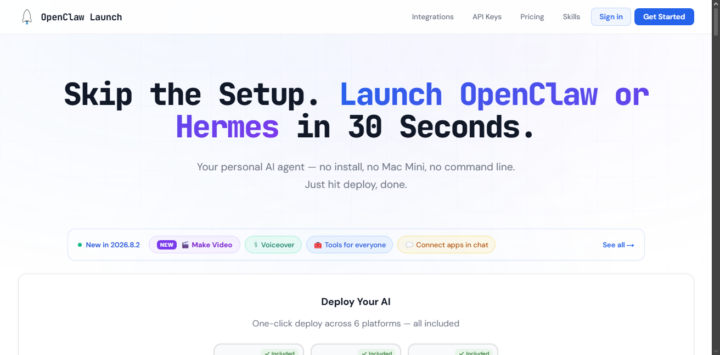
If you just want to see what an always-on AI agent actually feels like before committing real money, OpenClaw Launch is currently the cheapest legitimate way in. The hosting runs $3 for the first month, then $6/month after that, and Hermes Agent hosting on its own dedicated, natively-hosted instance starts at $3/month, undercutting nearly everything else on this list.
Interestingly, deployment is genuinely fast too, roughly 30 seconds through a visual configurator, with automatic SSL, health checks, and container monitoring bundled in. A tip to have in mind: if you prefer the OpenClaw framework’s interface but want to run it on a Hermes-series model instead (Hermes 4 405B, Hermes 4 70B, or Hermes 3), OpenClaw Launch lets you do that via OpenRouter on the same managed infrastructure, so you’re not locked into picking one agent framework and one model family together.
PROs:
- Offers the lowest entry price of any managed OpenClaw or Hermes host
- No Docker, SSH, or manual SSL setup required
- Deploys through a simple configurator
- Supports Telegram, Discord, WhatsApp, WeChat, and web chat out of the box
- Flexible mixing of the OpenClaw framework with Hermes-series models via OpenRouter
CONs:
- Thinner compute allocations than Cloudways or MyClaw at the same tier
- Not best for AI agents running critical workloads.
4. Hosting.com AI Application Studio (visit) => Best for Vibe-Coded Applications
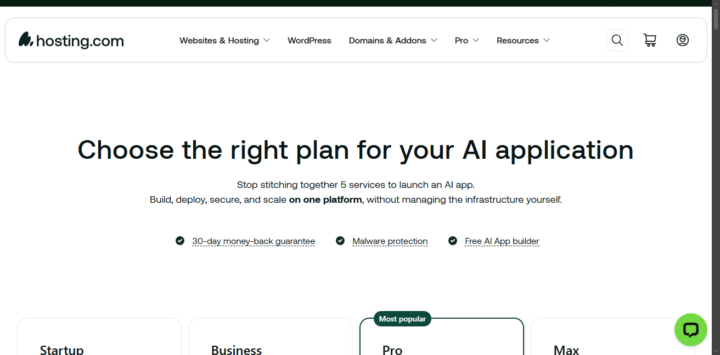
Unlike the others on this list, Hosting.com’s AI Application Studio is a managed hosting package for vibe-coded applications and websites, not necessarily AI agents. So, this one comes in as a great choice if your “AI agent” is literally a vibe-coded app that needs production-grade infrastructure behind it.
The AI app studio runs on Cloudflare Enterprise’s always-on CDN across 330+ points of presence and AMD EPYC infrastructure, with two core workflows: “Build,” using hosting.com’s own Nova-powered AI studio, and “Launch,” for deploying projects you’ve already built elsewhere straight from Git. Pricing is credit-based across three tiers; the Free plan offers 5 AI build credits and hosts just one application; the Startup plan offers 15 credits and 20GB of disk space for up to five applications.
PROs:
- Cloudflare’s always-on CDN and AMD EPYC infrastructure across all plans
- Built-in Web Application Firewall, Monarx behavioral malware detection, DDoS mitigation, and rate limiting against AI API abuse
- One-click deployment straight from Cursor, Windsurf, or similar AI coding tools via Git
- Transactional email, SSL, domain management, and daily backups all bundled in
CONs:
- Not suitable for true autonomous-agent hosting
- Credit-based pricing caps how many builds or apps you can run at the lower tiers
5. OMC Cloud (visit) => Best Budget VPS for CrewAI, AutoGen, and LangGraph
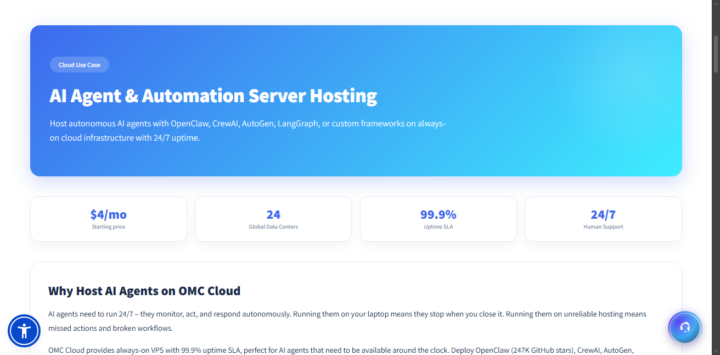
Shifting from OpenClaws and Hermes, here’s a new autonomous AI agent hosting platform that allows you to host your AI agents built on various platforms. OMC Cloud’s plain, always-on VPS allows you to host OpenClaw, CrewAI, AutoGen, LangGraph, or a custom setup, starting at a genuinely low $4/month across 24 global data centers with a 99.9% uptime SLA.
You get full root access; that is to say, you can install and configure the framework yourself, and you can connect to any LLM provider and any messaging platform (Signal, Telegram, Discord, WhatsApp, Slack) without being restricted to a pre-built integration list. Server provisioning takes around 2 minutes maximum, and you get to choose the data center, CPU/GPU, RAM, storage, and OS to match whatever framework you’re running.
PROs:
- Falls among the cheapest raw agent-hosting compute on this list
- Supports multiple AI agent platforms.
- Grants root access for developers who want to install and customize their own stack
- Fast provisioning across 24 global data center locations
CONs:
- Root access means you’re responsible for framework installation, updates, and security patching yourself
- No dashboard for one-click agent deployment the way Cloudways or MyClaw offer
6. Google Vertex AI Agent Engine (visit) => Best for Gemini-Native Enterprise Agents
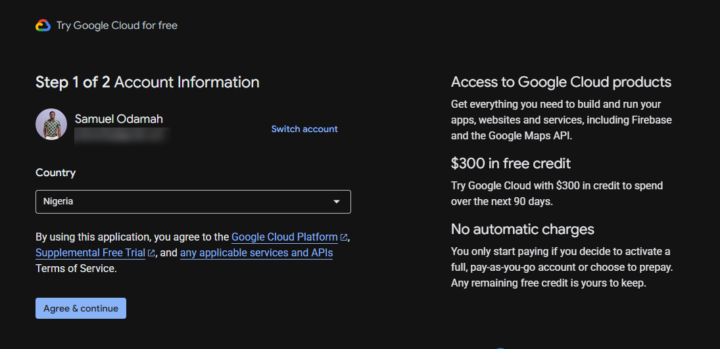
Google rebranded Vertex AI Agent Builder into the “Gemini Enterprise Agent Platform” at Cloud Next 2026. Vertex AI Agent Engine is Google Cloud’s managed platform for building and deploying enterprise agents with visual no-code tools; you just drag and drop what you need, and you’ll get a free $300 if you’re a first-timer.
The actual pricing runs on a pay-as-you-go model: $0.0864 per vCPU-hour for runtime and $0.0090 per GB-hour for memory, undercutting AWS AgentCore slightly on both counts, plus a free tier covering 50 vCPU-hours and 100GB-hours of memory per month. Vertex AI Search adds $1.50 to $6.00 per 1,000 queries on top.
PROs:
- Free $300 credits for first-time Google Cloud users
- Slightly cheaper per-vCPU-hour and per-GB-hour than AWS Bedrock AgentCore
- A genuinely usable free tier for prototyping before you commit real spend
- Offers the deepest integration if your stack already runs on Gemini models and Google Cloud
- Bundles Agent Studio, the Agent Development Kit, Agent Engine, and 200-plus models under one platform
CONs:
- No flat monthly fee, so a single user question can trigger charges across four separate meters at once
- Real-world production costs can go from a few dollars in testing to $2,000+ per month
- Some billing components (Sessions, Memory Bank) are still being rolled out through 2026, so full costs aren’t finalized yet.
7. AWS Bedrock AgentCore (visit) => Best for Enterprise-Scale, AWS-Native Agents
AgentCore is AWS’s full re-architecture of its agent offering, and it’s already replaced the older Bedrock Agents (Bedrock Agents Classic). AWS AgentCore is built for systems of agents that share memory, delegate tasks to each other, and route through a unified Gateway.
Runtime, Browser, and Code Interpreter components bill at roughly $0.0895 per vCPU-hour and $0.00945 per GB-hour, and importantly, you’re not charged for idle time while an agent sits waiting on a model response or a tool API. The catch is that AgentCore spans 12 independently billable components across Runtime, Gateway, Memory, Identity, Policy, Evaluations, Web Search, and the newer Agent Registry, each with its own metering pattern.
PROs:
- You only pay for active compute; idle session time isn’t billed
- Deep native integration with AWS IAM, VPC isolation, and audit trails for regulated industries
- Agent Registry ships with a genuinely useful free tier (5,000 records, 1M search calls/mo)
- Built for real multi-agent orchestration with shared memory and a unified tool gateway
CONs:
- Dealing with up to 12 separately billable components can accumulate your total bill to very high numbers
- Strictly AWS-locked; there’s no path to run it outside Amazon’s cloud
8. Azure AI Foundry Agent (visit) => Best for Microsoft-Stack Businesses
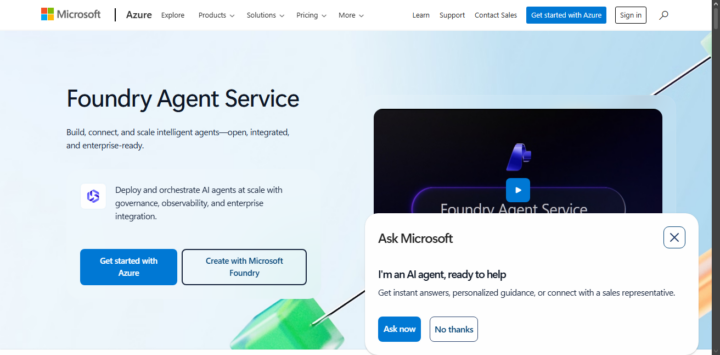
With Azure AI Foundry Agent, there’s no additional charge to create or run Foundry-native agents built with prompts and workflows; you only pay for the model tokens and any Tools or Foundry IQ connections you use, like Azure Logic Apps, Microsoft Fabric, SharePoint grounding, or Bing Search grounding.
What makes Foundry Agent Service particularly interesting for developers already invested elsewhere is its support for “hosted agents,” which lets you run agents built with external open-source frameworks, including LangGraph and Microsoft’s own Agent Framework, inside customer-dedicated managed containers with built-in scaling, observability, and governance handled by Microsoft.
For organizations that want to save on the model-and-tools spend, Microsoft also offers an Agent Commit Units pre-purchase plan, letting you buy usage upfront at a discount and apply it flexibly across Foundry and Copilot Studio services.
PROs:
- Zero base platform fee for creating and running Foundry-native agents
- Genuinely useful if you’ve already built an agent in LangGraph and want a managed container to run it in
- Strong enterprise governance
- Deep, natural fit for organizations already living in SharePoint, Fabric, and the wider Microsoft 365 stack
CONs:
- “Free platform” is a bit misleading once model tokens, Tools, and IQ connections start stacking on top
- The Agent Commit Units pre-purchase system adds an extra layer of billing complexity
- The real value only shows up clearly if you’re already deep in the Azure and Microsoft 365 ecosystem
9. LangSmith (visit) => Best for Custom-Coded LangGraph Agents
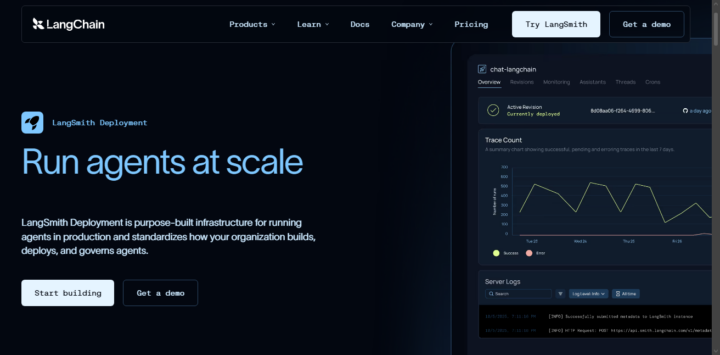
Developed by the team behind LangChain, LangSmith (previously LangGraph Platform) is a full-suite AI agent and LLM observability platform with tracing and real-time monitoring. The platform debugs agents, finds failures fast, and tracks latency. It also adds durable persistence, horizontal scaling, task queues, and cron scheduling to your AI agent deployments.
The free Developer tier alone covers up to 100,000 node executions per month, self-hosted, which is genuinely generous for hobbyist or early-stage projects. Beyond that, the Plus tier bundles a LangSmith Plus subscription at $39 per seat per month, then layers on usage charges of roughly $0.001 per node executed plus a small per-minute standby fee for keeping a deployment warm. Enterprise pricing is custom and covers cloud, hybrid, or fully self-hosted deployment with SSO and RBAC.
PROs:
- The core framework is free forever
- The free Developer tier plan offers up to 100,000 monthly node executions
- Offers granular, code-level control to teams
- Inherits LangSmith’s SOC 2 Type II, HIPAA (with BAA on Enterprise), and GDPR compliance
CONs:
- Seat-based Plus pricing adds up fast; a five-person team can be looking at roughly $195/mo before any usage
- Does not support serverless environments like Vercel or Cloudflare Workers
10. CrewAI AMP (visit) => Best for Multi-Agent Orchestration Teams
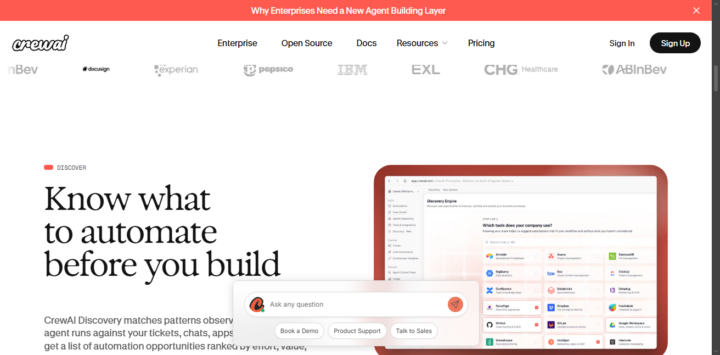
CrewAI’s core framework, which is a lightweight Python library purpose-built for orchestrating teams of collaborating agents, is free, open-source, and has real enterprise adoption. AMP is the managed layer for teams that want a visual Studio, an AI copilot for building workflows, tracing, guardrails, and role-based access control without running their own infrastructure.
The AMP platform’s pricing sits at just two tiers: a free Basic plan with 50 workflow executions per month, and a custom-quoted Enterprise plan; there used to be a mid-tier Professional plan that cost $25/month for 100 executions, but it’s been discontinued. For organizations that legally can’t send data to an external platform, CrewAI also offers Factory, a containerized, self-hosted deployment option that runs on-premises or in your own private cloud instead of CrewAI’s hosted SaaS.
PROs:
- The underlying framework is free and MIT-licensed
- AMP adds a real Visual Studio, AI copilot, observability, and guardrails on top of the free framework
- “Factory” offers a proper on-premises path for teams with strict data-sovereignty requirements
- Free Basic tier is enough to genuinely evaluate the platform before paying anything
CONs:
- The useful $25/mo Professional tier was discontinued, leaving a big gap between free and custom Enterprise pricing
- LLM token costs routinely run two to three times the platform fee itself, since one “execution” can trigger many agent-to-agent calls
| Service | Best For | Starting Price |
| Cloudways | OpenClaw and Hermes on official managed infrastructure | $9.99/mo |
| MyClaw | Premium dedicated hosting for OpenClaw and Hermes Agent | ~$16.77–29/mo |
| OpenClaw Launch | The cheapest managed entry point for OpenClaw or Hermes | $3–6/mo |
| Hosting.com | Hosting AI-generated and vibe-coded applications | Free tier available |
| OMC Cloud | Budget, framework-agnostic VPS for CrewAI, AutoGen, LangGraph | $4/mo |
| Vertex AI Agent Engine | Gemini-native agents inside Google Cloud | Free tier available |
| AWS Bedrock AgentCore | Enterprise-scale, AWS-native agent deployment | Pay-per-use |
| Azure AI Foundry Agent | Microsoft-stack businesses and hosted LangGraph agents | Platform is free |
| LangGraph Platform | Custom-coded LangGraph agents that need real determinism | Free tier, then $39/seat |
| CrewAI AMP | Multi-agent orchestration teams | Free tier, then custom |
Conclusion
If you just want to try running an always-on personal assistant, Cloudways, MyClaw, and OpenClaw Launch will get an OpenClaw or Hermes instance live within minutes, and the honest difference between them mostly comes down to how much you want to pay for dedicated resources versus rock-bottom pricing.
OMC Cloud sits in between for anyone who wants root access and freedom to run whatever framework they like. But if you’re building an agent into an actual product, the calculus changes entirely, and AWS, Google, and Microsoft’s platforms, alongside LangGraph and CrewAI’s managed layers, are really the only ones built to survive a compliance review or a sudden 10x in traffic.