
Reverse phone lookup websites became popular, and many loved them, but truthfully, they seemed to have invaded many people’s privacy. Obviously, not everyone wants their crucial personal details to be out there online, and although most of these phone lookup services simply collate publicly shared data, it doesn’t sit well with some people; hence, this USPhoneBook Opt Out guide for 2026 and beyond.
That said, if you figured out your details are exposed in the USPhoneBook lookup service, here are different ways you can go about removing your personal data from their database. The USPhoneBook service lists people’s phone numbers, home addresses, and family connections, sourced from public databases. One good thing with USPhoneBook is that they have a documented data removal process, which means you can have them delete all records of your data that are in their database. But of course, it’s not really a straightforward process.
How Did USPhoneBook Get My Data?
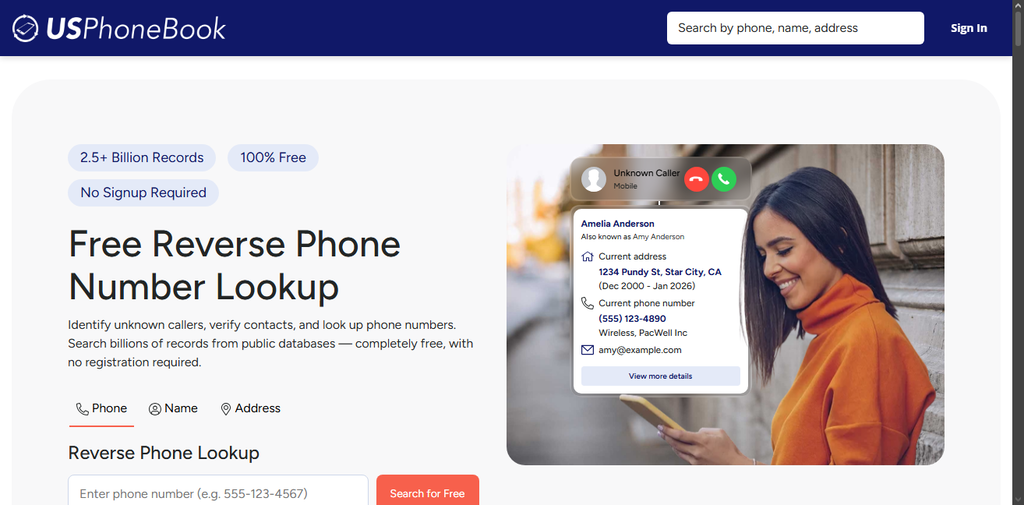
USPhoneBook, like every other people-search or reverse-lookup website, scrapes together publicly available records, buys data from other brokers, and sometimes pulls from social media activity, then packages it all into a searchable profile that anyone on the internet can view for free or at a cost.
No, they don’t need you to sign up and provide these details, and that’s precisely the problem. Left unchecked, such personal data exposure can make you an easy target for scam calls, phishing attempts, and even stalking, since social engineering attacks tend to work best when the scammer already has a few real details about you to sound convincing.
But as I noted earlier, USPhoneBook, unlike most other similar sites, does have a documented removal process, and there’s more than one way to get it done. Yeah, some of the removal methods are completely free but require a bit of patience; others cost money but take the recurring hassle off your hands entirely.
USPhoneBook Opt Out Guide: 5 Ways To Remove Yourself in 2026
If your listing is a one-off annoyance, the free methods will handle it. If you’ve discovered you’re scattered across dozens of broker sites, not just USPhoneBook, the paid route starts to make a lot more sense.
1. Fill Out USPhoneBook’s Online Opt-Out Form
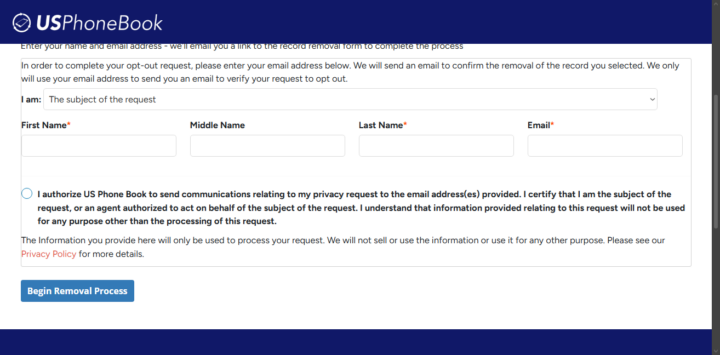
This is the primary, officially supported way to remove your listing, and it’s completely free; however, the process is a two-form flow separated by an email verification step:
- Go to the removal page and fill in your first name, last name, and email address, then check the authorization box and solve the reCAPTCHA.
- Click “Begin Removal Process.” You’ll land on a page confirming an email has been sent to you.
- Check your inbox, but check your spam folder first. The verification email (titled something like “Complete your usphonebook.com Privacy Request”) tends to land straight in spam on Gmail by default.
- Click the link inside within 24 hours, or it expires.
- Fill out the second, more detailed form with your date of birth, phone number, street address, city, state, and zip code, then confirm and submit.
According to USPhoneBook, removal takes 3 days or less once the second form is submitted. Honestly, I’d advise using a burner email address for this rather than your primary email, because there’s a certain irony in handing a data broker a fresh piece of contact information while trying to get your existing data removed from them.
2. Call USPhoneBook’s Removal Line by Phone
If the online form keeps erroring out, or the verification email never shows up (even after digging through your email’s spam folder), or you’d simply rather talk to a human, USPhoneBook also accepts opt-out requests by phone. The phone number to call is (888) 747-4095 (an alternative number shared by online users is (469) 983-2441). Before you dial, you should have the following ready:
- The full URL of your listing, if you have it.
- Your full legal name
- Current and past addresses
- Any phone numbers and email addresses tied to you
Ask the representative for a reference number or a written confirmation by email once the request is logged. That way, if the listing doesn’t disappear within a reasonable window, you’ve got something concrete to point back to.
3. Use the Contact Form
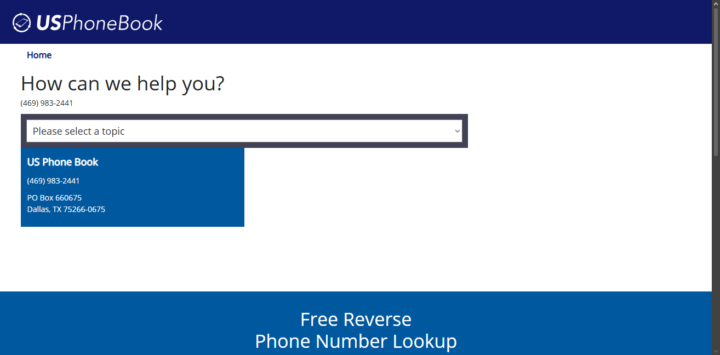
All these still circle back to one thing, but yeah, the idea of knowing there are many ways to go about a thing still intrigues. So, yeah, you can submit a request through USPhoneBook’s contact form, especially if you’ve called earlier and it seemed nothing happened. The contact form to fill out is on USPhoneBook’s contact page; you’d have to enter your name, email address, the URL of your listing, and a message clearly stating that you’re submitting a privacy or opt-out request under applicable state privacy laws.
Be sure to include enough matching details, like your name, phone number, and current/past addresses, so the team can accurately locate the record you’re referring to.
4. Mail a Written Opt-Out Request
If you’re gon’ try it the traditional way, then yeah, this one could work. I mean, this is still technically reaching out to them via their contact page. The address to mail your request is as follows:
USPhoneBook PO Box 660675 Dallas, TX 75266-0675
Your letter should include:
- A clear statement that you’re requesting removal/opt-out
- Your full legal name, plus any previous names or aliases
- Current and past addresses
- Phone numbers and email addresses associated with you
- Your signature and the date
However, it is important to note that this method takes noticeably longer than every other method listed here, and the reason is obvious: The mail transit time, plus USPhoneBook’s processing window. This is the slowest free method to opt out of the USPhoneBook database, but it leaves the clearest physical paper trail if you ever need to prove you made the request.
5. Engage a Third-Party Data Removal Agency
Yeah, there are lots of them that exist for this purpose: to erase your information from online data banks. You’ve got DeleteMe, Incogni, Aura, Cloaked, and many others. So, what you do is reach out to any of these services, provide them with your details, such as your name, email, and address, authorizing them to act on your behalf in removing those details (and related information) as you have provided from online databases.
These services would then scan data broker databases, submit removal requests, and, critically, keep re-scanning and resubmitting on a schedule since brokers like USPhoneBook continuously rebuild their listings from fresh public records. You get a dashboard showing which brokers are pending, in progress, or completed.
Then of course, these services don’t come free, and they don’t often come cheap either. Pricing varies by plan and the service provider. DeleteMe starts around $6.97 to $8 per month, while Aura starts from $7 to $12 per month. So, now you have a price range to expect for these sorts of services.
Is USPhoneBook even legal?
Yes, they are, and that’s part of the deal: knowing they’ve got your information, legally. USPhoneBook operates as a legitimate reverse-lookup service, pulling from public records and third-party data sources rather than hacking anyone. According to its own privacy policy, it collects identifiers, characteristics permitted by California’s public-records exemptions, internet activity data, and geolocation data, then organizes it into a browsable profile.
Because it deals with California residents, it’s bound by the California Consumer Privacy Act (CCPA).
Conclusion
It is worth knowing that USPhoneBook shares an operator (Mississippi Tornado Alley LLC) with two sister sites, FastPeopleSearch and PeopleSearchNow. Opting out of one doesn’t reliably clear your data from the others, so if you’ve found yourself on those too, you’ll need to repeat the process separately for each.
At the end of the day, it appears getting your information off USPhoneBook isn’t complicated; it’s just a bit tedious if you go the free route, and that’s fine. The same trick can also be applied to other popular people search directories harvesting people’s data, with little regard for their privacy.