
A good bag of coffee often comes with tasting notes, an origin story, and a few words from the roaster. The instructions that matter when you actually pull a shot can be harder to carry from bag to kitchen. Meraki’s CoffeeSense system proposes a small but tangible design change: a supported bag or card can be tapped on the machine to bring that roaster’s suggested recipe directly into the brewing workflow.
At a recent Meraki showcase in New York, coffee roaster Ryan Vaxmonsky demonstrated the machine using coffee bags and branded cards from his shop before guests tried making drinks themselves. The experience highlighted a practical benefit for home users: the same recipe guidance remains available the next morning, even without a professional roaster on hand.

The CoffeeSense Concept: Roaster Recipes via NFC
- Stored Parameters: The chip transfers the roaster’s recommended grind size, dry dose weight, water temperature, and final liquid yield.
- Guidance, Not Sensor Analysis: The chip provides a stored baseline recipe rather than actively analyzing bean moisture or roast age.
- Dialing-In Baseline: While beans naturally age and atmospheric humidity shifts over time, having the roaster’s precise baseline eliminates the initial waste of coffee during dial-in.
Workflow Integration: Built-In Scales and Step-by-Step Dosing
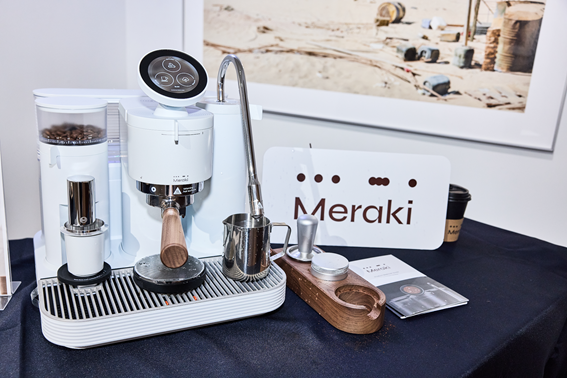
- Integrated 45-Setting Grinder: Paired with an integrated scale that doses ground coffee strictly by weight rather than time.
- Brew-Area Scale: Sits flush beneath the drip tray to track liquid yield in real time and automatically halt extraction when the target output is hit.
- 58 mm Commercial Standard: The machine utilizes a standard 58 mm portafilter group, ensuring compatibility with standard third-party baskets, tampers, and distribution tools.
Under the Hood: Dual Boilers and Commercial Internals
| Specification | Hardware Detail | Practical Benefit |
| Boiler System | Dual Boiler (Dedicated Brew & Steam) | Simultaneous extraction and milk steaming without temperature drops |
| Pump | Commercial-grade Rotary Pump | Consistent, quiet 9-bar pressure delivery |
| Thermal Stability | PID Controller & Actively Heated Group Head | Precise brew water temperature consistency from first shot to last |
| Interface | Integrated Front Touchscreen | Replaces external scales, timers, and grind displays in one central hub |
| Dimensions | 370 × 370 × 415 mm | Compact footprint, though clearance is required for portafilter handling |
Automation vs. Craft: Where the Tech Stops
- Hands-on Puck Prep: The user must still distribute, level, and tamp the puck properly to avoid channeling.
- Milk Texturing: The commercial steam wand features an auto-off temperature sensor, but texturing the microfoam and pouring latte art remains a manual craft.
- Full Manual Flexibility: For coffee bags without NFC tags, the interface functions as a standard, fully manual dual-boiler machine, allowing users to dial in any bean manually.
Meraki CoffeeSense Espresso Machine Price and October Discount Offer
The Meraki Espresso Coffee Machine’s regular price is $1,999. There’s an October promotional price of $1,799 for those buying the hardware now. The offer also includes a complimentary six-piece Upgrader Kit valued at $210.
- Included Accessories: The promotional bundle includes a six-piece “Upgrader Kit” valued at $210, which provides essential barista tools: a calibrated spring tamper, milk pitcher, Weiss Distribution Technique (WDT) needle tool, dosing funnel, shot glass, and a puck screen.