
Voltage gets treated like a headline spec; bigger number, better bike — the same way peak wattage often does. It isn’t that simple. Voltage is one input into how a bike performs, not a verdict on its own, and two real bikes from the same brand make that easy to see: The lower-voltage one has more torque than the higher-voltage one.
While a higher voltage spec sheet looks impressive, without the right controller, motor winding, and drivetrain, more volts won’t guarantee more speed or torque.
What Voltage Actually Does

Power equals voltage times current. Raise the voltage and the same power can be delivered through less current, which is the real, direct effect of a higher-voltage system, not “more power” by itself, but the option of more power without pushing more current through the wiring and controller to get it.
Whether that option actually gets used depends on how the rest of the system (the controller’s current rating, the motor’s winding, and the battery’s capacity) is built around it. Voltage alone doesn’t decide torque, top speed, or range; it decides how much room the rest of the system has to work with.
Counter-Example One: The Lower-Voltage Bike With More Torque
HappyRun’s own lineup makes this concrete. The F18 2.0 runs at 60V and produces 245 N·m of torque, the highest figure in the lineup. The G300 Pro runs at 72V, a full 12 volts higher, and produces 120 N·m, roughly half. If voltage determined torque, that comparison would run the other way.
What actually explains it is “the drive type”, not voltage: the F18 2.0 is mid-drive, sending power through a chain and sprocket that multiplies torque through gearing, the same way a lower gear makes a hill easier on a pedal bike.
The G300 Pro is hub-drive, delivering power straight to the wheel without that mechanical leverage. Voltage had almost nothing to do with the outcome.
Counter-Example Two: Same Voltage, Different Everything Else
The reverse comparison is just as telling. The F18 2.0 and the G18 Pro are both 60V bikes, yet almost nothing else about them matches. The F18 2.0 carries a 30Ah battery — 1,800 Wh — with a 6,000W peak motor and up to 60 miles of range. The G18 Pro carries a 35Ah battery — 2,100 Wh — with a 4,500W peak motor and up to 75 miles of range, the longest in the lineup.
The same voltage, meaningfully different capacity, peak output, and range. If voltage were the number that mattered most, two bikes sharing it should perform more alike than these two actually do.
Controller and Motor: The Parts That Actually Decide Output
The component doing the real work of turning volts into usable power is the controller, paired with how the motor is wound. A controller’s current rating, combined with the voltage it’s fed, sets the practical ceiling on power, which is why the F18 2.0, at 60V, still reaches a 6,000W peak that lands close to the 72V G300 Pro’s 6,500W: a controller and motor built to handle higher current can close most of that gap even without the voltage advantage.
Voltage sets the terms the controller and motor operate under; it doesn’t replace the job they do.
Thermal Management: Where Higher Voltage Has a Real, if Modest, Edge
This is the one place higher voltage has a genuine, well-established advantage in principle: delivering the same power at higher voltage means lower current, and resistive heating in wiring and windings scales with current, not power directly. Less current for the same output means less heat generated in those components, all else being equal.
That’s a real electrical engineering tendency, not a guarantee about how any specific bike actually runs: motor design, riding conditions, and sustained load all affect real-world heat just as much, and none of the bikes here have published comparative thermal test data to confirm how it plays out in practice. It’s a legitimate reason higher voltage can help, not proof that it does on any particular ride.
Weight Isn’t a Voltage Story Either
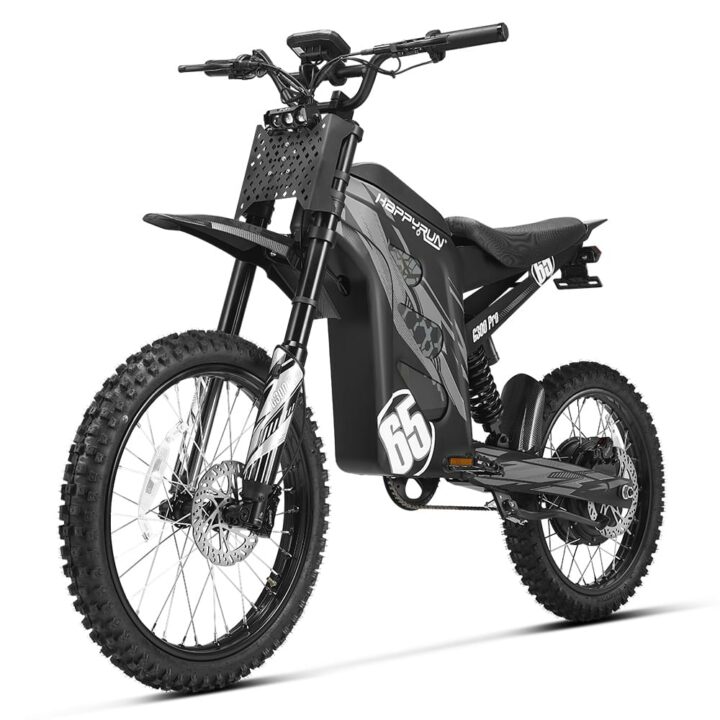
The G300 Pro, at 72V, has a documented curb weight of 136.8 lbs. That number comes from its battery’s cell count and capacity, its frame material, and its overall build: Not from its voltage.
A 72V pack with fewer total cells can weigh less than a 60V pack with more of them, since weight tracks total energy storage and construction, not the voltage figure printed on the spec sheet. There’s no consistent rule that higher voltage means a heavier (or lighter) bike.
Reading Beyond the Voltage Number
None of this makes 60V or 72V the “right” choice in general. It means the voltage figure on its own doesn’t answer torque, range, weight, or heat questions: Those come from the battery’s watt-hours, the motor and controller pairing, and the drivetrain, checked individually rather than assumed from one number. Comparing an electric dirt bike on voltage alone skips past the specs that actually predict how it rides.
Voltage Is One Input, Not the Verdict of Perfection or Imperfection
A higher voltage number can matter, but only as one part of a system that includes the controller, the motor winding, the battery’s real capacity, and the drivetrain. It is not a stand-in for how strong, fast, or efficient a bike turns out to be. The F18 2.0 and G300 Pro comparison alone is proof enough: the 60V bike out-torques the 72V one, for reasons that have nothing to do with voltage at all.
Judging powerful electric dirt bikes by the full spec sheet, such as torque, Wh, drive type, and documented weight, rather than the voltage number alone is what actually predicts how a bike performs, not the figure that happens to appear first on the page.