
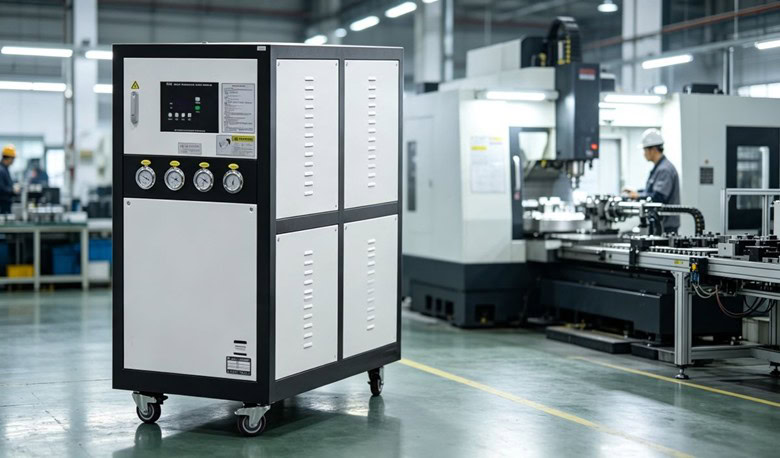
CNC spindles, laser systems, welding equipment, and automation lines all generate heat during operation. When that heat isn’t controlled, it doesn’t just make the equipment run hot. It can affect machining precision, shorten component life, and lead to unplanned downtime. That’s why reliable cooling isn’t optional for manufacturing equipment. It’s part of keeping production stable.
Choosing the right chiller isn’t as simple as picking several tons or kilowatts, though. You also need to think about flow rate, temperature control, ambient conditions, and power supply. This guide walks through what actually matters when selecting an air-cooled industrial chiller, so you can make a decision based on your equipment’s real requirements rather than guesswork or a single spec on a datasheet.
Why Industrial Equipment Needs Reliable Cooling
Most industrial equipment produces heat as a byproduct of normal operation. A little heat isn’t a problem. The trouble starts when that heat has nowhere to go, and it builds up faster than the surrounding environment can absorb it. Left unmanaged, that heat causes three kinds of problems.
Overheating
Components running above their rated temperature wear out faster and are more likely to fail without warning.
Temperature instability
A CNC spindle that heats and cools unevenly can drift out of tolerance. A laser source running hot may lose output power or see its service life shortened.
Downtime risk
Thermal issues rarely announce themselves in advance. They show up as sudden faults, which means lost production time and, often, an unplanned service call. A properly sized chiller isn’t just about comfort or convenience. It’s a piece of your uptime strategy.
When Should You Choose an Air-Cooled Industrial Chiller?
Air-cooled and water-cooled chillers both have a place in manufacturing. The right choice depends on your facility, not just your budget.
Air-cooled often makes sense when:
- Your facility doesn’t have easy access to a cooling water source
- You want to avoid installing and maintaining a cooling tower
- Installation needs to stay simple, with minimal site preparation
- The equipment runs as a standalone unit, not part of a larger centralized system
- You’d rather not manage the added complexity of a water loop
Water-cooled may be the better fit when:
- You’re cooling a large, continuous production system
- Your facility already has a centralized cooling water system in place
- Ambient temperatures at your site run consistently high
- Energy efficiency is a top priority, and the infrastructure to support it already exists
Neither option is universally better. The right answer depends on what your facility already has, what you’re trying to cool, and how it operates day to day.
Air-Cooled vs. Water-Cooled Industrial Chillers
Here’s how the two options compare on the factors that matter most for a purchasing decision.
| Factor | Air-Cooled | Water-Cooled |
| Installation | Simpler, fewer components | More infrastructure required |
| Cooling tower | Not required | Often required |
| Water consumption | Minimal | Higher |
| Maintenance | Relatively straightforward | More components to service |
| High ambient heat | More sensitive to it | Often performs better |
| Large centralized systems | Less suitable in some cases | Often the better fit |
For standalone or mid-sized manufacturing equipment, air-cooled chillers often offer a simpler cooling solution with less infrastructure to install and maintain. For large, centralized facilities, water-cooled systems are frequently the more appropriate choice.
Key Factors When Choosing an Air-Cooled Industrial Chiller
Once you’ve decided air-cooled is the right direction, a handful of factors will determine whether the unit you buy actually does its job well.
Cooling Capacity
This is the first thing to get right, and it isn’t as simple as bigger is better. Capacity needs to match your equipment’s actual heat load, not just its nameplate power rating. Consider your operating conditions, ambient temperature, whether the equipment runs continuously or intermittently, and build in a reasonable safety margin.
Flow Rate
Cooling capacity and flow rate are not the same thing, and it’s easy to overlook flow rate when comparing chillers. A unit can have plenty of cooling capacity on paper and still fail to deliver the coolant flow your equipment actually needs. Check both numbers, not just one.
Temperature Range and Control Accuracy
Different equipment needs different coolant temperatures, and some applications are far more sensitive to fluctuation than others. CNC spindles and laser systems, in particular, tend to need tighter temperature stability than general industrial cooling applications. If your process is precision-dependent, control accuracy matters as much as the temperature range itself.
Power Supply
A chiller with the right cooling capacity isn’t much use if its electrical requirements don’t match your facility. Before you buy, confirm voltage, phase, and frequency against what’s available at the installation site. U.S. manufacturing facilities commonly run 115V, 230V, or 460V service at 60Hz, so it’s worth checking this early rather than after the unit arrives.
Ambient Operating Conditions
This one gets overlooked often, and it shouldn’t be. Air-cooled chillers reject heat into the surrounding environment, so ambient temperature and ventilation directly affect how well the unit performs. High ambient heat, poor airflow, and tight installation spaces can all reduce a chiller’s effective cooling output, even when it’s correctly sized on paper.
Protection and Reliability Features
For equipment that runs continuously, protection features matter as much as raw cooling power. Look for high and low pressure protection, overload protection, flow protection, freeze protection, and clear alarm functions. These features are what keep a minor issue from turning into a shutdown. A chiller that shuts itself down safely and flags the problem is far easier to live with than one that fails silently and takes your production equipment down with it.
How Much Cooling Capacity Does Your Equipment Need?
If your equipment manufacturer has already published a recommended air-cooled chiller capacity, heat load, flow rate, or coolant temperature, start there. That guidance should take priority over any general estimate. When that information isn’t available, work through it step by step instead of relying on a fixed formula.
- Identify the equipment’s actual heat load, not just its nameplate power rating
- Factor in real operating conditions, including how often and how hard the equipment runs
- Add a reasonable safety margin rather than sizing to the exact minimum
- Confirm the flow rate and temperature requirements alongside capacity
A device’s rated electrical power and its actual heat output are often different numbers. Sizing a chiller off the wrong one is one of the more common mistakes buyers make.
Choosing an Industrial Chiller for Different Applications
CNC Machines and Spindles
Temperature stability matters most here. Spindle temperature swings translate directly into machining tolerance issues, so consistent flow rate and steady temperature control should be top priorities.
Laser Cutting and Welding Equipment
Cooling capacity and reliability come first. These systems tend to run hard for extended periods, and a chiller that can’t keep pace will affect both beam quality and equipment lifespan.
Industrial Automation Equipment
Along with adequate cooling capacity, compact installation, stable cooling, and easy maintenance can be important considerations, since automation cells are often installed in tight, shared spaces. A smaller footprint and straightforward service access matter, but only once the cooling capacity itself is correctly matched to the load.
A Few Mistakes Worth Avoiding
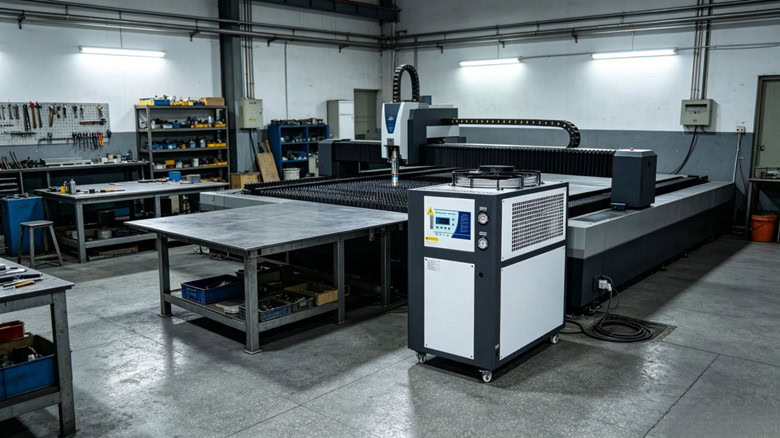
Even experienced buyers run into the same few pitfalls. Sizing a chiller off nameplate power instead of actual heat load is the most common one, and it usually leads to an undersized system. Skipping the flow rate check is another. A chiller can look perfectly matched on cooling capacity alone and still underperform once it’s installed. Ignoring ambient conditions at the installation site is a third: a unit that performs well in a test lab can fall short in a hot, poorly ventilated corner of a plant floor.
None of these mistakes are hard to avoid. They just require checking the right numbers before you buy, not after. A few extra minutes spent confirming heat load, flow rate, and site conditions up front can save weeks of troubleshooting later.
What to Look for When Buying an Air-Cooled Industrial Chiller
Before you commit to a unit, run through this final check:
- Cooling capacity matched to your equipment’s actual heat load
- Flow rate that meets your equipment’s requirements
- Temperature range and control accuracy suited to your process
- Voltage, phase, and frequency that match your facility’s power supply
- Ambient operating conditions at the installation site
- Protection functions, pump performance, and realistic maintenance needs
Before purchasing, match the chiller’s cooling capacity, flow rate, temperature requirements, and electrical specifications against your equipment manufacturer’s stated requirements. That single step catches most sizing mistakes before they become expensive ones.
For manufacturers looking for a compact air-cooled solution, ATO Automation offers industrial water chillers across a range of cooling capacities, flow rates, temperature ranges, and power configurations. Buyers can compare the available specifications against their equipment’s actual heat load and operating requirements before selecting a suitable model.