
Hydrogen is showing up in more industrial settings every year. Energy plants, manufacturing lines, laboratories, and battery facilities all rely on it in growing amounts. That growth brings a real safety question: how do you build reliable hydrogen leak detection into a facility before a leak becomes dangerous?
Choosing a hydrogen gas detector is not just about picking a detection range from a spec sheet. Sensor technology, installation location, alarm behavior, environmental conditions, and long-term maintenance all shape whether a detection system actually protects a facility. This guide will walk you through the factors that matter most when selecting a hydrogen gas detector for industrial use.
Why Hydrogen Detection Matters
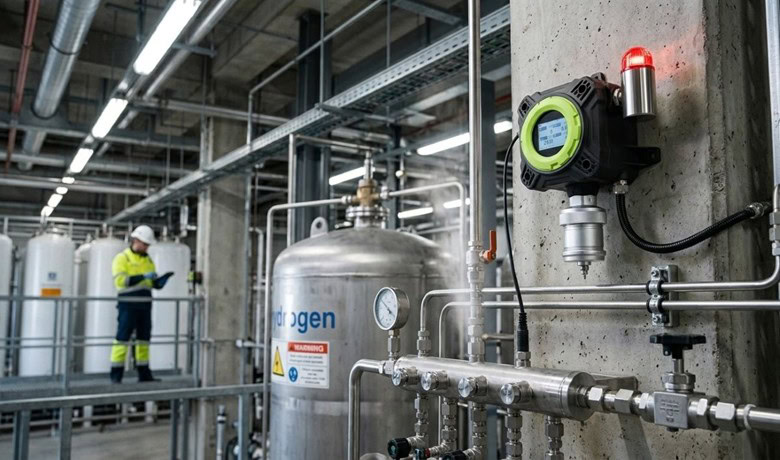
Hydrogen is colorless and odorless, so people cannot sense a leak on their own. It is also highly flammable and far lighter than air, which means it rises quickly and can collect in poorly ventilated high spaces. A small leak can turn into a serious hazard faster than many other gases.
Early detection is the difference between a routine maintenance response and an emergency. The real challenge is not simply detecting hydrogen somewhere in a facility. It is detecting it reliably, in the right location, at the right concentration, before it spreads.
Where Hydrogen Leaks Can Occur
Hydrogen risk shows up in more places than most teams expect. Fittings, seals, and connection points often develop small leaks long before a major failure occurs, so hydrogen leak detection needs to cover more than the obvious equipment. Common sources include:
- Hydrogen storage tanks and cylinders
- Production systems and electrolyzers
- Fuel cell systems
- Pipelines, valves, and connection points
- Battery and energy storage facilities
- Chemical processing equipment
- Laboratories and manufacturing lines
Each application has a different layout and risk profile. That is exactly what should drive how many detectors a facility installs, and where.
For industrial installations, fixed hydrogen gas detectors such as those available from GasDog should be evaluated not only for detection performance but also for mounting options, environmental protection, power requirements, and integration with the site’s alarm or control system.
Common Industrial Applications for Hydrogen Detection
- Hydrogen production: watch electrolyzers, storage, and piping connections for leaks.
- Storage and distribution: focus on cylinders, valves, and fittings.
- Fuel cell systems: monitor the hydrogen supply line and enclosed equipment spaces.
- Battery and energy facilities: watch for accumulation in areas with limited ventilation.
- Laboratories: account for small-scale use and frequently changing experimental setups.
- Chemical and manufacturing facilities: cover processing equipment and pipeline runs.
Fixed vs. Portable Hydrogen Gas Detectors
Most facilities need a mix of both types, not just one.
| Type | Best Use |
| Fixed gas detector | Continuous, automated monitoring in permanent locations |
| Portable gas detector | Personal inspection, leak checks, and maintenance work |
| Area monitor | Temporary coverage for larger or short-term work zones |
Fixed hydrogen gas detectors suit production facilities, storage areas, and equipment rooms where hydrogen must be watched around the clock and tied into an automated alarm system. Portable detectors fit maintenance and inspection work, where a technician needs a reading in a specific spot at a specific time.
Because fixed detectors operate continuously, they are better suited to applications where hydrogen levels need to be monitored around the clock rather than checked periodically by personnel. Many facilities use both: fixed units cover the permanent risk points, while portable devices support maintenance and inspection.
What Sensor Technology Works Best for Hydrogen?
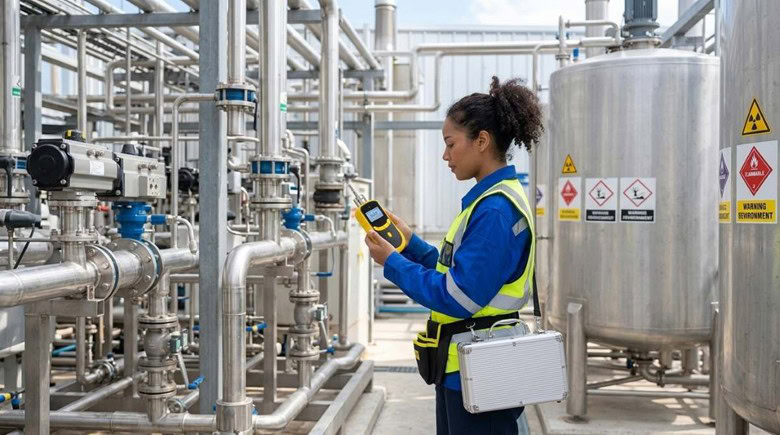
Sensor choice should be based on the application, not on which technology sounds the most advanced.
- Electrochemical sensors: Well suited to certain gases; confirm they match the target concentration range and site conditions.
- Catalytic combustion sensors: Commonly used for combustible gases, including hydrogen at flammable concentrations.
- Semiconductor sensors: Useful in some hydrogen sensing applications, though selectivity and stability need review.
The right choice depends on the gas concentration range, environmental conditions, response time, and the risk of interference from other gases nearby. No single sensor type is automatically the best one for every site.
Sensor selection should be tied to the intended measurement purpose. Applications focused on confirming combustible concentrations may call for a different sensing approach than applications that require early leak detection at lower concentrations.
What Specifications Should You Compare?
Detection Range and Alarm Levels
A wider detection range does not automatically mean better protection. What matters more is how the range relates to your low-level warning and high-level alarm thresholds, and whether those thresholds match your facility’s actual risk points.
For combustible-gas applications, buyers should also understand how a detector’s measurement range and alarm thresholds relate to hydrogen’s lower explosive limit, or LEL. Some applications call for monitoring well below the LEL to catch a leak early, while others focus on confirming when a combustible concentration has been reached.
Accuracy and Response Time
Accuracy affects how much confidence you can place in a reading. Response time affects how quickly an alarm triggers once a leak starts. Given how fast hydrogen can accumulate, fast response time is worth prioritizing.
Alarm and Relay Functions
Look for audible alarms, visual alarms, and multi-level alarm stages, along with fault alarms that flag when the unit itself needs attention. Detecting hydrogen is only useful if the detector is operating correctly, so fault monitoring matters for catching sensor failure, wiring problems, or other issues that could leave an area without coverage.
Relay outputs matter too. A fixed detector can trigger ventilation systems, shut valves, or feed into a broader safety control system through relay outputs or a communication interface.
Communication and Power
Many industrial detectors support 4–20 mA output, RS485, or Modbus, allowing readings to feed into a central monitoring system. The exact protocol matters less than confirming it is compatible with your existing controls. On the power side, check whether the detector runs on 24V DC or AC power, and whether backup power is needed to keep monitoring active during an outage.
IP Rating and Environmental Protection
Dust, moisture, temperature swings, and humidity all affect long-term reliability. Match the IP rating to the actual conditions at the installation site, not just the general category of facility.
Where and How Should Hydrogen Gas Detectors Be Installed?
Because hydrogen is lighter than air, it tends to rise after a leak. That makes high points, ceilings, and enclosed upper spaces important areas to monitor, along with any zone near a known potential leak source.
That said, placement should not be reduced to a single rule like “always mount it on the ceiling.” Room geometry, ventilation patterns, and the specific location of leak sources all shape the right installation point. A detector placed without that context can miss a leak even if the equipment itself is excellent.
Installation decisions also need to account for the surrounding environment. Temperature, humidity, dust, corrosive gases, and general ventilation all influence detector performance over time. If the site qualifies as a hazardous area, confirm the detector meets the applicable requirements, which may include ATEX, IECEx, UL certification, or other applicable local standards. These are not interchangeable labels, so verify which specific certification and installation rules apply to your site before purchase.
How Many Detectors Does a Facility Need?
There is no fixed formula, and floor area alone is not a reliable guide. The right number depends on facility layout, the number of hydrogen sources, likely leak points, ventilation patterns, ceiling height, and whether any zones qualify as hazardous areas. Detector quantity should come from a layout review and risk assessment, not a simple square-footage calculation. A site-specific risk assessment or application review can help translate a facility layout into a practical coverage plan.
Sensor Life, Calibration, and Maintenance
This is where many selection guides fall short, even though it is central to real ownership cost.
- Sensor lifetime: Varies by technology and operating environment; check the manufacturer’s expected life under your actual conditions, not a generic figure.
- Calibration: Plan for initial calibration, a periodic calibration schedule, and access to the correct calibration gas.
- Cross-interference: Ask what other gases or environmental conditions could affect sensor readings at your site.
Total cost of ownership goes well beyond the purchase price. It includes calibration, sensor replacement, and ongoing maintenance. Weighing those costs upfront avoids surprises later.
Final Considerations When Choosing a Hydrogen Gas Detector
The right hydrogen gas detector is the one that matches your gas concentration range, sensor technology, installation environment, alarm requirements, communication needs, and long-term maintenance plan. It’s not a “one spec fits all” kind of story.
When continuous monitoring is required, Gas Dog fixed hydrogen gas detectors can be considered for industrial applications where permanent monitoring is needed. Buyers should evaluate available models based on detection range, sensor technology, alarm functions, environmental protection, communication options, and installation requirements. The goal is not simply to choose a detector with the most features, but to select a system that provides reliable coverage for the facility’s actual hydrogen risks.