
Manufacturing equipment depends on stable power. Yet many facilities deal with fluctuating input voltage, long cable runs, phase imbalance, and sudden current spikes when motors start. These issues rarely announce themselves clearly. Instead, they show up as unexpected downtime, inconsistent machining, motor overheating, or components that fail sooner than expected.
The problems tend to build up quietly. A motor that runs slightly hot for months, or a control system that resets a little too often, can look like a maintenance issue when the real cause is upstream: the voltage feeding it was never quite stable to begin with.
Choosing a three-phase voltage stabilizer is not simply a matter of matching the rated kVA to your equipment. Buyers need to weigh input voltage range, load characteristics, phase balance, regulation accuracy, and operating conditions together, since each of these shapes how well the stabilizer performs once it is installed.
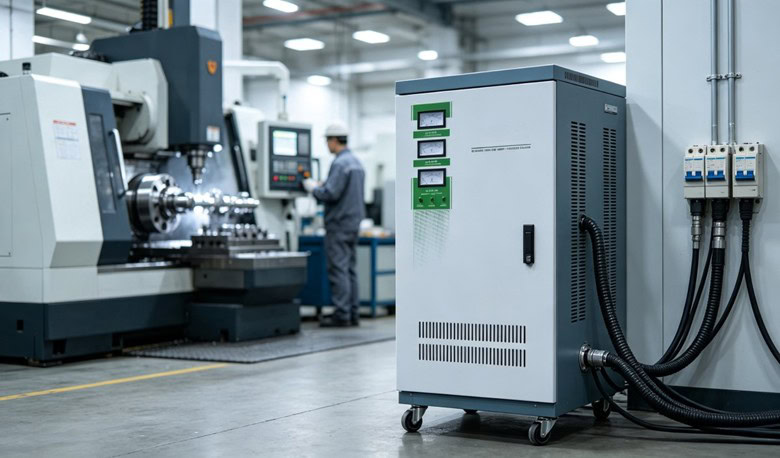
When Does Manufacturing Equipment Need a Stabilizer?
Not every facility needs one. A three phase voltage stabilizer becomes worthwhile when one or more of the following conditions apply.
- Unstable utility voltage. Peak-hour demand, long distribution lines, or remote facilities often cause voltage to drift outside the safe range.
- Sensitive CNC and automation equipment. CNC controls, PLCs, servo drives, and sensors are far more sensitive to voltage swings than simple resistive loads.
- Motor-driven loads with high starting current. Motors, compressors, pumps, and fans can draw several times their running current at startup.
What really determines whether you need a stabilizer isn’t just how much the voltage fluctuates. It’s also how sensitive your equipment is, and how much a brief voltage dip could cost you in downtime or rejected parts. For facilities facing these conditions, a three phase servo voltage stabilizer from PowerHome can be considered as part of the power protection strategy, particularly where continuous voltage correction is needed for industrial machinery and production equipment.
What Should You Consider When Choosing a Stabilizer?
Here are some of the chief things to have at the top of your list when choosing a voltage stabilizer for home or industrial use:
Input Voltage Range
Check the normal voltage range at your facility, along with its maximum and minimum swings under real operating conditions. Don’t just look at a stabilizer’s rated input voltage; look at its actual correction range. A wider input range means the unit keeps correcting through larger swings, so your equipment spends less time outside its preferred voltage window.
Output Voltage
Common outputs include 380V, 400V, 415V, and 480V, though some equipment has more specific requirements. The right output voltage should match your equipment and your facility’s distribution system, not a generic industry default. Many stabilizers offer configurable output voltage, which is useful for facilities running mixed-voltage equipment.
Regulation Accuracy
Regulation accuracy is usually expressed as ±1%, ±3%, or ±5%. Tighter accuracy isn’t automatically better — it depends on your load. CNC machines, automation controls, and precision electronics generally benefit from tighter regulation, since even small voltage swings can affect performance. Servo-controlled stabilizers are often chosen specifically because they hold tighter output regulation under varying loads.
Three-Phase Configuration and Phase Balance
A three-phase system doesn’t guarantee that all three phases carry equal load. Single-phase loads spread unevenly across the three phases are common, especially in older facilities or mixed-equipment lines, and this imbalance is easy to overlook during selection.
If a facility has noticeably uneven phase loading, a three-phase voltage stabilizer with independent phase regulation can correct each phase separately, rather than adjusting all three together. Measuring the current on each phase during normal operation is usually enough to tell whether this matters: if one phase consistently draws more than the others, phase balance should factor into the selection rather than being treated as a secondary detail.
Protection features, cooling method, and customization options are worth confirming as well, since they affect how the unit fits into an existing electrical room and how it holds up under continuous industrial use.
How to Size a Stabilizer Correctly
Sizing is where many selection errors occur, largely because continuous load, startup current, and phase loading are often evaluated separately instead of together.
Start With the Actual Continuous Load
Don’t just add up the nameplate power of every piece of equipment in the facility. Real-world running loads are almost always lower, since not everything runs at full capacity at the same time.
Account for Motor Starting Current
Continuous load and starting load are not the same thing. Motors, compressors, and pumps can briefly draw significantly more current at startup than during normal operation. A stabilizer that looks correctly sized based on running wattage alone may still be undersized the moment a large motor starts.
Leave an Appropriate Safety Margin
A margin of 20–30% is a reasonable starting point, though it isn’t a fixed rule. Motor-heavy systems, intermittent loads, harsh operating environments, or planned future expansion may call for a larger margin.
Consider Unbalanced Loads Separately
If phase loading is uneven, sizing by total kVA alone isn’t enough. Checking the load on each individual phase can reveal a phase that’s undersized even when the overall total looks comfortable.
As a working example, a facility with an 80 kVA continuous load and a 25% operating margin would target roughly 100 kVA of capacity. If the system includes large motors or compressors with significant starting current, that figure may need to move higher after further evaluation.
Servo Stabilizer vs. Other Power Protection Solutions
A servo voltage stabilizer is not the only option, and it isn’t a universal replacement for the others.
| Solution | Primary Function | Best For |
| Servo Voltage Stabilizer | Continuous voltage correction | Industrial machinery, production equipment |
| UPS | Backup power, short-term voltage conditioning | Sensitive electronics, brief outages |
| Transformer | Voltage conversion or isolation | Changing voltage levels |
| Surge Protection | Transient overvoltage protection | Lightning strikes, switching surges |
A three phase servo voltage stabilizer makes sense when your main challenge is continuous voltage fluctuation affecting motors, CNC equipment, or production lines. A UPS is more appropriate when the concern is short power interruptions rather than ongoing voltage drift. A transformer solves a different problem — changing voltage levels, such as converting 480V to 240V. Surge protection guards against transient events like lightning, not gradual voltage swings.
These solutions aren’t interchangeable, and in many facilities, more than one is used together. A three phase voltage stabilizer handling ongoing voltage correction and a UPS covering short outages, for example, address two different risks rather than competing for the same job.
How Stabilizers Protect Different Equipment Types
CNC machines are particularly exposed to voltage instability, since it can interrupt controls and create inconsistent operating conditions from one cycle to the next. A voltage stabilizer helps by keeping the supply within the range these controls are designed for, which tends to mean fewer unplanned interruptions rather than any improvement in machining precision on its own.
Motors and compressors respond to undervoltage with increased electrical stress and heat, which shortens their service life over time. Keeping the supplied voltage within a narrower band reduces that stress and can lower the frequency of overheating-related shutdowns.
Automated production lines depend on PLCs and sensors that don’t tolerate voltage swings well; a brief dip can trigger a fault or an unexpected shutdown even when nothing is mechanically wrong. Stable input power gives these control components a more consistent baseline to operate from.
Industrial electronics — drives, controllers, and instrumentation — sit at the sensitive end of the spectrum. For this equipment, the benefit of a three phase voltage stabilizer is less about preventing failure outright and more about reducing the everyday voltage-related disruptions that erode reliability.
Choosing the Right Three-Phase Voltage Stabilizer for Your Facility
- Light industrial loads: relatively stable voltage, moderate load, limited motor starting — a standard capacity model is usually sufficient.
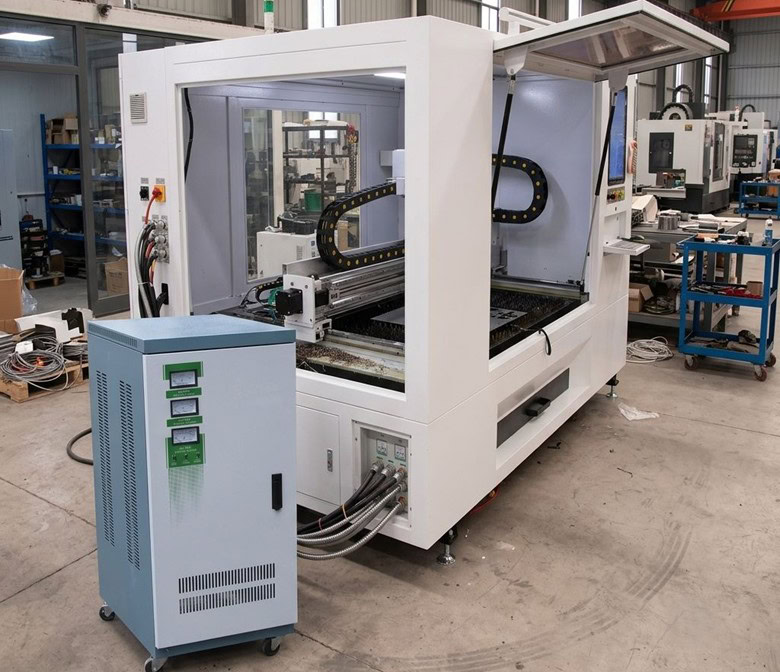
- CNC and precision manufacturing: prioritize tighter regulation accuracy and stable output.
- Motor-heavy production lines: account for starting current, and size with a generous safety margin.
- Facilities with unbalanced loads: look for independent phase regulation and monitoring.
Industrial models are typically available across a wide range of capacities, so it’s worth matching capacity to both your current load and reasonable future expansion. If you’re unsure which category best describes your facility, it often helps to walk through the sizing steps above with real measurements rather than nameplate estimates.
Conclusion
The right three-phase voltage stabilizer should be selected according to actual load, motor starting requirements, input voltage variation, phase balance, and required regulation accuracy. Rather than choosing a model based on kVA or price alone, buyers are better served by evaluating the complete operating environment and leaving enough capacity for real-world conditions and future expansion.
A well-chosen stabilizer isn’t just a power accessory. For facilities dealing with wide input fluctuations, unbalanced loads, or demanding three-phase equipment, sizing and specifying the unit correctly can meaningfully reduce downtime and extend the working life of the equipment it protects.
Where to Buy
For facilities ready to compare specific models, PowerHome offers three-phase voltage stabilizers for industrial applications, with different capacity and voltage configurations available to match varying equipment requirements.