
Choosing the best large language model (LLM) for coding in 2026 is no longer just about finding a model that can write code. Developers also need reliable debugging, code review, long-context understanding, tool integration, and reasonable API costs.
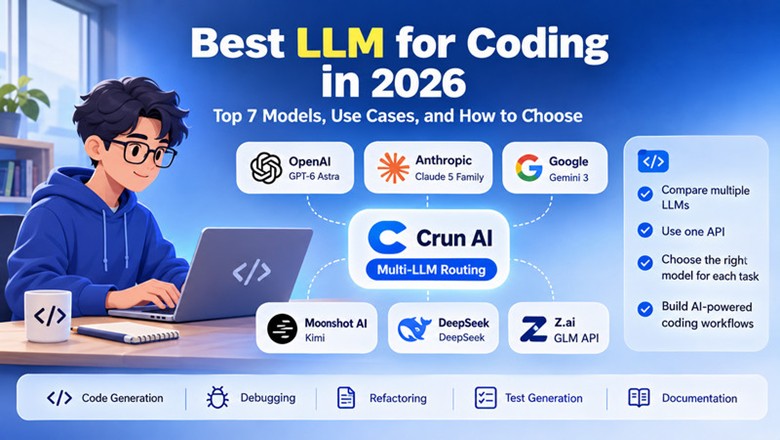
In this guide, we compare 7 coding LLM options: Crun AI, OpenAI GPT-6 Astra, Anthropic Claude 5, Google Gemini 3, Moonshot AI Kimi, DeepSeek, and Z.ai GLM API. We will explore their strengths, limitations, common use cases, and the factors developers should consider before choosing a model.
Why Use Large Language Models for Code Generation?
Large language models can understand programming instructions, generate code, explain errors, and help developers complete repetitive tasks. When connected to tools such as code editors, terminals, and test environments, they can also support more complex development workflows.
For Individual Developers
For solo developers, coding LLMs can cut the time it takes to move from an idea to a working application.
Common benefits include:
- Faster development: Generate functions, API endpoints, scripts, and basic application structures from natural-language instructions.
- Easier debugging: Explain error messages, identify potential causes, and suggest fixes.
- Learning support: Understand unfamiliar programming languages, libraries, and frameworks.
- Less repetitive work: Automate boilerplate code, documentation, and basic test generation.
- Rapid prototyping: Build and test an initial version of an application before investing in a larger development effort.
For Teams
Development teams can use coding LLMs to improve consistency and reduce repetitive work across the software development lifecycle.
Potential applications include:
- Reviewing pull requests and explaining code changes.
- Generating unit tests and integration tests.
- Refactoring legacy code into more maintainable structures.
- Creating technical documentation and onboarding materials.
- Supporting internal developer tools and AI-powered coding agents.
The Top 7 LLMs for Coding in 2026
The following 7 options represent different ways to use AI for software development.
This is a practical comparison, not a universal performance ranking. Results depend on the programming language, task, context, tools, and model version. Before making a production decision, test the available models against your own coding workload.
1. Crun AI: Multi-LLM Routing
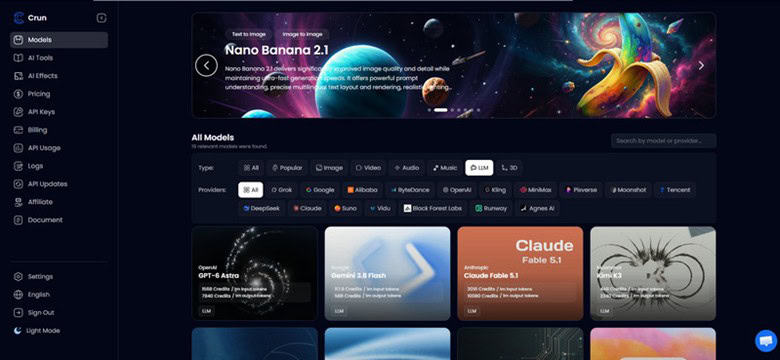
Crun AI is a unified AI API platform that helps developers access and integrate multiple AI models through one platform. Instead of relying on a single provider, developers can explore models from OpenAI, Anthropic, Google, Moonshot AI, DeepSeek, and Z.ai, including
GPT-6 Astra, the Claude 5 family, Gemini 3, Kimi, DeepSeek, and GLM API.
Its key advantage is multi-model flexibility. Developers can compare different LLMs for code generation, debugging, code review, refactoring, and AI agent development, then choose the models that best fit their needs.
Strengths
- Access to multiple LLMs. Explore models from different providers and select suitable options for different coding tasks, from routine code completion to complex reasoning.
- Simplified API integration. Reduce the work involved in connecting multiple AI providers, making it easier to build and maintain AI-powered applications.
- Flexible model selection. Compare coding quality, response speed, and pricing to find the right balance between performance and cost.
- Support for AI development. Use different models in applications such as coding assistants, AI agents, SaaS products, and automated development workflows.
Limitations
Crun AI is a multi-model platform rather than a single coding model, so results vary by the underlying model selected. Developers should verify current model availability, API compatibility, pricing, context limits, and tool-calling support before implementation.
Best for: Developers who want to compare multiple coding LLMs, reduce the complexity of managing separate integrations, and build flexible AI-powered applications through a unified API platform.
2. OpenAI: GPT-6 Astra
GPT-6 Astra is OpenAI’s flagship model for demanding reasoning and software engineering tasks, which is specially designed for complex coding, multi-step workflows, and professional work involving tools and external environments.
It is available through the OpenAI API and supported development products, subject to the applicable access and usage conditions.
Strengths
- Complex problem-solving. Astra is designed for tasks that require more than generating an isolated function, such as investigating bugs, reasoning about architecture, and implementing changes across a project.
- Agentic coding workflows. Its support for tool-based workflows can help coding agents move between code, files, and other supported environments.
- Long-context work. Its documented context window is 1.05 million tokens, which can be useful when working with extensive project documentation or large collections of source files. Actual usefulness depends on retrieval quality and how the application manages context.
- Flexible reasoning. Developers can adjust reasoning effort to balance the demands of a task with response time and resource use.
Limitations
Astra’s flagship capabilities come with trade-offs. Its API pricing is relatively high on a per-token basis, so large-scale usage should be evaluated carefully.
Best for: Complex software engineering, multi-step coding agents, difficult debugging, and projects where code quality matters more than minimizing every request’s cost.
3. Anthropic: Claude 5 Family
Anthropic’s Claude 5 family is designed for advanced reasoning, coding, and professional knowledge work. Its Fable series targets demanding software engineering tasks, while the broader family offers options for different performance and cost requirements.
Strengths
- Working with complex code. Advanced Claude models can help developers understand unfamiliar modules, trace dependencies, and reason through changes that affect multiple files.
- Code review and refactoring. Claude can explain existing implementations, identify potential design problems, and suggest ways to improve readability and maintainability.
- Long-running tasks. Models designed for extended workflows can support coding agents that need to investigate a problem, make changes, and review the results over multiple steps.
- Clear explanations. Claude is also useful for explaining code decisions and producing technical documentation that developers can share with teammates.
Limitations
The most capable Claude models may be expensive for frequent, high-volume use. Their speed and availability can vary by model, plan, and API configuration.
Performance also depends on the surrounding tools. A model that can reason about a patch cannot guarantee that the patch compiles, passes tests, or behaves correctly in production.
Best for: Developers working with complex repositories, large refactoring tasks, code review, and extended AI-assisted development sessions.
4. Google: Gemini 3
Google’s Gemini 3 family offers coding and reasoning capabilities, including models designed for software engineering, agents, and enterprise workflows. Different variants serve different needs, so developers should select the specific model rather than treating the entire family as one product.
Strengths
- Large-context workflows. Models with large context limits can help developers analyze extensive documentation, code files, and project requirements together.
- Multimodal input. Depending on the model, developers may be able to provide screenshots, diagrams, or other supported inputs alongside text. This can help when implementing a user interface from a visual reference.
- Agent development. Gemini models can support applications that combine reasoning with tools and multi-step execution.
- Google ecosystem integration. Teams already using Google Cloud may find it convenient to evaluate Gemini alongside their existing infrastructure and development services.
Limitations
Capabilities vary by model version, and not every Gemini variant offers the same context window, reasoning features, or speed.
Developers should also consider integration requirements, API pricing, regional availability, and compatibility with their coding tools. Strong multimodal capabilities do not automatically mean better results on every programming task.
Best for: Developers building AI agents, working with visual references, analyzing large amounts of project information, or integrating coding assistance into Google-based workflows.
5. Moonshot AI: Kimi
Moonshot AI develops the Kimi family of models, which includes options for coding, long-context work, and multi-step tasks. Kimi can be accessed through its API ecosystem, with integration details depending on the selected service.
Strengths
- Long-horizon tasks. Coding models designed for extended work can help developers break complicated requests into smaller steps and maintain context across a workflow.
- Repository analysis. With appropriate file access and context management, Kimi can help summarize unfamiliar projects, investigate dependencies, and propose changes.
- API compatibility. Kimi’s OpenAI-compatible API format can simplify integration for applications that already use compatible client libraries, although individual features may differ.
- Agentic development. Kimi can be evaluated for coding-agent workflows that involve planning, tool use, and iterative problem-solving.
Limitations
Not every Kimi model has identical coding capabilities. Developers must check the selected model’s context limits, tool support, and performance on their own tasks.
API access, billing, and model availability may also differ between Kimi Code and the Kimi Open Platform. Confirm which service you are using before configuring your application.
Best for: Developers exploring alternative coding models, long-context analysis, and AI agents that perform multi-step development tasks.
6. DeepSeek
DeepSeek offers API-accessible models that developers can integrate into coding assistants and AI applications. Its API documentation includes compatible request formats and support for using DeepSeek with third-party coding tools.
Strengths
- Cost-conscious development. DeepSeek is worth evaluating when API expenditure is an important part of the decision. Compare current prices and actual task costs instead of assuming that every model or request is equally inexpensive.
- Reasoning and debugging. Suitable models can assist with algorithm design, error analysis, code explanation, and technical problem-solving.
- Integration flexibility. API compatibility with common client formats can make it easier to connect DeepSeek to existing applications and coding assistants.
- High-volume workflows. Developers can test DeepSeek for repetitive tasks such as code explanations, simple generation, and automated classification of development issues.
Limitations
Performance varies across model versions and task types. A lower-cost model may require additional prompts, retries, or human review, which can reduce its apparent savings.
Developers should also evaluate tool-calling behavior, latency, rate limits, data-handling terms, and the model’s ability to follow project-specific conventions.
Best for: Developers seeking an alternative to premium coding models, especially for workloads where cost and integration flexibility are important.
7. Z.ai: GLM API
Z.ai provides access to GLM models through its API ecosystem. Developers can use these models for code generation, reasoning, and AI-powered application development, with exact capabilities depending on the model and service plan.
Strengths
- Coding-oriented workflows. GLM models can be evaluated for generating functions, explaining code, debugging errors, and supporting coding agents.
- Developer integration. OpenAI-compatible API options can make it easier to connect GLM to existing applications and tools.
- Alternative model choice. GLM gives developers another option to benchmark when selecting a balance of capability, speed, and cost.
- Flexible access options. Depending on the service, developers may choose general API access or a coding-focused plan. The two can use different endpoints and billing arrangements.
Limitations
Developers need to verify the exact GLM model available under their plan. API endpoints, supported parameters, quotas, and model access may differ across services.
Best for: Developers who want to evaluate alternative coding models, build AI-assisted workflows, and compare coding-focused access options.
Common Use Cases for Coding LLMs
Coding LLMs can assist with almost every stage of software development. Their value depends on how well the model understands the task and how effectively developers validate its output.
Code Generation
Developers can describe a feature in plain language and ask an LLM to generate the corresponding code.
Code Completion
Code completion helps developers finish functions, predict the next lines of code, and suggest implementations while they work.
Boilerplate Code
LLMs can generate repetitive structures such as API routes, database models, configuration files, and standard CRUD operations.
Refactoring
Refactoring improves code structure without changing its intended behavior.
Debugging
When a program fails, developers can provide the error message, relevant code, expected behavior, and steps to reproduce the issue.
The model can suggest likely causes and potential fixes. For difficult bugs, an iterative workflow that includes running code and examining test results is usually more useful than relying on a single answer.
Test Generation
LLMs can generate unit tests, integration tests, and edge-case scenarios based on existing code.
Code Translation
LLMs can translate code between programming languages or frameworks.
A developer might convert a JavaScript utility into Python or migrate an older implementation to a newer framework. The model should account for differences in language behavior, libraries, types, and error handling rather than translating syntax alone.
Documentation
LLMs can generate function descriptions, README files, API documentation, and explanations of unfamiliar code.
They can also help create onboarding guides for new team members. Review the output against the actual implementation to avoid documenting features or behavior that do not exist.
How to Choose the Right LLM for Your Needs
The best coding LLM depends on your development environment, project complexity, security requirements, and budget. Consider the following factors before choosing one.
Solo, Team, or Enterprise Use
Solo developers often benefit from an affordable model that handles everyday coding tasks and integrates with their preferred editor.
Development teams may need stronger repository analysis, code review, shared workflows, and consistent output across multiple developers.
Enterprises should also consider administrative controls, access management, audit requirements, contractual commitments, and support availability.
A multi-model platform such as Crun AI can be useful when an application needs access to several models. Teams that already depend on one provider’s tools may prefer its native ecosystem.
Regulatory and Security Needs
Before sending source code to an external model, review the provider’s data retention policies, training practices, access controls, and applicable data-processing terms.
For sensitive projects, check whether the service supports the required data residency, retention controls, and enterprise security arrangements.
Do not assume that an API is suitable for confidential code simply because it offers a paid plan. Security requirements should be verified against the specific service and contract.
Integration and Workflow Fit
A strong model is less useful if it does not fit your development workflow.
Check whether it supports your preferred SDK, code editor, coding agent, function-calling format, and required context length. Also consider whether it can access files, run tests, or interact with tools through your chosen environment.
If you plan to switch models frequently, API compatibility and a consistent integration layer can reduce migration work. However, different providers may implement parameters and advanced features differently.
Cost and Infrastructure Preferences
Compare more than the advertised price per million tokens.
Consider input and output token rates, prompt caching, reasoning usage, retries, latency, and the number of requests needed to complete a task. A more expensive model may cost less per completed task if it needs fewer attempts.
For high-volume workloads, consider routing routine tasks to a lower-cost model and reserving advanced models for complex problems, where your platform and workflow support that approach.
If you prefer greater infrastructure control, investigate whether an appropriate model can be self-hosted. Self-hosting may reduce dependence on an external API, but it introduces hardware, maintenance, deployment, and security responsibilities.
Type of Code You Work With
Different projects place different demands on an LLM.
- Web development: Prioritize framework knowledge, frontend and backend coordination, and debugging.
- Large repositories: Look for effective context handling, repository search, and multi-file reasoning.
- AI agents: Evaluate tool calling, planning, iterative execution, and recovery from errors.
- Data engineering: Test SQL generation, data transformations, and correctness on representative datasets.
- Mobile development: Check support for your frameworks, platform-specific APIs, and build workflows.
- Legacy systems: Prioritize code comprehension, dependency analysis, and safe refactoring.
The most reliable way to choose is to test two or three candidates against real tasks from your project. Measure correctness, completion time, cost, and the amount of manual correction required.
FAQs
Which LLM Is Best for Coding Now?
There is no single best model for every coding task.
GPT-6 Astra and advanced Claude 5 models are worth evaluating for complex software engineering. Gemini 3 may suit developers who need multimodal input or agent-oriented workflows. Kimi, DeepSeek, and GLM offer additional options to test for coding, reasoning, and cost efficiency.
Crun AI is worth considering if you want to access and compare multiple models through a unified platform.
The right choice is the model that delivers reliable results on your actual workload at an acceptable cost.
Is There Any LLM Better Than Claude for Coding?
Yes, depending on the task.
GPT-6 Astra may be a strong alternative for complex reasoning and multi-step software engineering. Gemini 3 may fit workflows that combine coding with visual input or other Google services. DeepSeek and other alternatives may be attractive when cost is a major concern.
What Is the Cheapest LLM That Can Still Handle Coding?
The answer depends on current pricing, the specific model version, and your workload.
DeepSeek, selected GLM models, and other lower-cost options are worth testing for routine code generation, explanations, and simple debugging. A smaller or faster model may be sufficient for these tasks, while complex architecture changes may require a more capable model.
Check current API pricing and calculate the total cost of completing a task, including retries and corrections. The lowest token price does not always produce the lowest development cost.
Is AI Replacing Coders?
AI is changing software development, but coding LLMs do not eliminate the need for skilled developers.
They can automate repetitive tasks, generate initial implementations, and help identify bugs. However, software engineers still need to understand requirements, design systems, evaluate trade-offs, protect data, and verify that applications work correctly.
Developers who learn to use AI tools effectively may spend less time on repetitive coding and more time on architecture, problem-solving, testing, and product development.
Conclusion
The best LLM for coding in 2026 depends on what you build and how you work. Advanced models such as GPT-6 Astra and Claude 5 are worth evaluating for demanding engineering tasks, while Gemini 3, Kimi, DeepSeek, and GLM provide additional choices for different workflows and budgets.
If you need to compare models or build applications that use multiple AI providers, Crun AI offers a unified API approach that can simplify model exploration and integration.
Before committing to one option, test representative coding tasks, review security requirements, and compare total costs. A well-chosen model, combined with effective testing and human oversight, can make software development faster without sacrificing reliability.