
Choosing a BLDC motor is only half the job. The controller determines how that motor actually behaves in the field. A brushless DC motor and controller work together as one system, not as two separate purchases.
A mismatched controller can leave torque on the table, cause overheating, or trigger nuisance faults under normal load. A well-matched controller lets the brushless DC motor run at its rated performance with a stable, predictable response.
The good news is that you do not need to compare every specification on a controller datasheet. Start with six things that have the biggest impact on compatibility: voltage, current, power, feedback, control method, and protection. Everything below walks through those six in order.
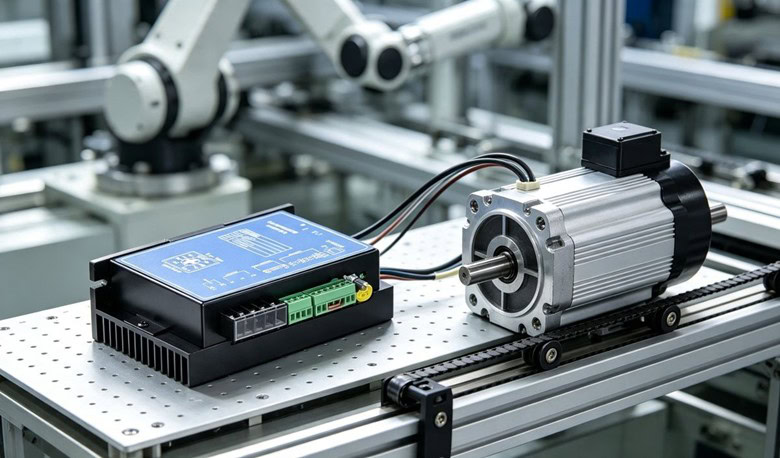
What Does a Brushless Motor Controller Do?
A BLDC controller manages every core function of the motor’s operation. Understanding these functions makes the matching process below much easier to follow.
- Commutation: Switches current through the motor windings in the correct sequence
- Speed control: Adjusts motor speed based on an input signal
- Current regulation: Keeps current within safe limits during acceleration and load changes
- Direction control: Enables forward and reverse operation
- Protection: Shuts down or limits output when a fault condition occurs
How to Match a BLDC Controller With a Motor
This is the section that answers the question most buyers actually have: which BLDC controller fits this motor? Work through each requirement below in order.
Motor Voltage
The brushless motor controller voltage range must cover the motor’s rated voltage, with some margin for supply fluctuation. Running outside this range is the most common cause of early controller failure, so it is always the first thing to check.
Current and Power Requirements
Once voltage is confirmed, check current and power in this order: normal running current, then startup and acceleration current, then power as a final sanity check.
Continuous current: Can the controller handle the motor’s normal operating current, with enough headroom for the actual load, duty cycle, and ambient temperature? Most controllers derate as they heat up, so the nameplate figure is a starting point, not a guarantee.
Peak current: Can it handle startup, acceleration, and short bursts of extra load? A controller sized only for steady-state current often stalls the moment the motor needs to accelerate.
Power rating: Does the controller’s power rating provide a reasonable final compatibility check? It is a useful confirmation, but it should stay secondary to voltage and current, since power definitions vary between manufacturers.
Motor Feedback and Sensors
First confirm whether your brushless DC motor uses Hall sensors or sensorless operation, since this decides which controller family you need. If the motor has Hall sensors, the brushless motor controller needs matching Hall inputs and compatible logic levels; sensorless motors need a controller with sensorless startup and commutation support.
If you are replacing an existing controller, the safest approach is to match the new controller to the brushless motor’s existing Hall configuration rather than assuming all Hall-sensor systems are interchangeable. Two setups can look identical on paper and still fail to run correctly if the supply voltage, wiring, or signal sequence does not match.
Control Method and Interface
Check how the controller expects to receive commands and what functions the application actually needs. Common speed inputs include PWM, 0 to 5V analog signals, and potentiometers, so confirm the brushless DC motor controller accepts the same signal type already used elsewhere in the system.
For example, if your PLC outputs a 0 to 10V speed signal but the controller only accepts PWM or 0 to 5V input, the two are not directly compatible without additional signal conversion. It is worth confirming this before ordering rather than discovering it during installation.
- Enable and disable control
- Forward and reverse switching
- Brake function
- Communication interfaces for PLC or automation integration
This is where a controller either fits an existing PLC or automation setup or turns into an extra integration problem, so it is worth confirming before purchase rather than after.
Protection Features
For industrial use, protection features are not optional extras. Look for overcurrent, overvoltage and undervoltage, overtemperature, stall protection, and Hall sensor fault protection. These features protect the brushless DC motor and controller from the everyday abuse of real operating conditions, including brief power dips, blocked airflow, or a jammed load that stalls the motor mid-cycle.
Example: Selecting a 24V BLDC Motor Controller
24V systems are common across automation, small pumps, and light industrial equipment, which makes this pairing worth a closer look. A 24V BLDC motor controller follows the same matching logic covered above, but a few points deserve extra attention at this voltage.
Confirm the controller’s actual input range comfortably covers 24V, including margin for supply sag under load, then check continuous and peak current against the motor’s real operating conditions rather than its nameplate figures alone. Current capacity deserves extra attention at 24V specifically: for the same power requirement, a lower system voltage draws more current. A 240W motor draws roughly 10A at 24V but only about 5A at 48V, so a 24V BLDC controller needs a meaningfully higher current rating to deliver the same power. Hall sensor compatibility and control signal type should match the rest of the 24V equipment already in use, and protection features should suit the installation environment.
It is also worth checking power supply compatibility, since many 24V systems share a single supply across multiple devices. Working through these points keeps 24V controller selection consistent across different motor models, rather than treating each purchase as a one-off decision.
Sensorless vs. Hall-Sensor BLDC Controllers
Both designs work well, but they suit different situations. The table below breaks down when a Hall sensor BLDC motor controller or a sensorless design tends to make more sense.
| Application Need | Better Fit |
| High starting torque | Hall sensor |
| Low-speed operation | Hall sensor |
| Frequent load changes | Hall sensor |
| Simple wiring | Sensorless |
| Cost-sensitive applications | Sensorless |
| High-speed operation with stable loads | Sensorless can be a good fit |
If the application needs strong torque from a standstill or runs at low speed with changing loads, Hall sensor control is generally the safer choice. If wiring simplicity and cost matter more than low-speed torque, sensorless control can be a good fit, though it is not automatically the better option for every high-speed application.
Open-Loop vs. Closed-Loop BLDC Control
Open-loop control sends commands to the motor without continuously checking actual speed. It is simpler and less expensive, but less precise under changing conditions.
Closed-loop control uses feedback to adjust brushless motor operation in real time. If the application needs accurate speed regulation or stable performance under varying loads, closed-loop control is generally the better fit.
Choosing a BLDC Controller for Different Applications
The right BLDC motor controller depends heavily on what the equipment actually needs to do. The list below highlights what to prioritize for each type of application.
- Automation: prioritize speed control accuracy, feedback, and PLC integration
- Robotics: prioritize low-speed torque and fast response to load changes
- Pumps: prioritize continuous current capacity and reliable overload protection
- Fans: prioritize efficiency and simple, steady speed control
- Conveyors: prioritize strong starting torque, smooth acceleration, and reversing
- Small industrial machinery: prioritize a correct voltage and current match, plus solid protection features
What to Check Before Buying a BLDC Controller
Before placing an order, run through this final checklist. It is short enough to copy into a purchasing note.
- Voltage range matches the motor and power supply
- Continuous current covers the expected operating current
- Peak current covers startup and acceleration
- Power rating falls within the controller’s recommended range, as a secondary check
- Hall sensor or sensorless configuration is compatible
- Control input and required functions, such as braking or reversing, are supported
- Protection and environmental ratings suit the application
When comparing suppliers, it is also worth checking whether the available controller models cover the voltage, current, feedback, and control requirements identified above. Brushless.com provides brushless motor controller options that can be evaluated against these specifications before purchase.
Need a BLDC Controller for Your Brushless Motor?
Matching a controller to a brushless DC motor really comes down to six decisions: voltage, current, power, feedback, control method, and protection. Working through them in order takes the guesswork out of the decision and avoids the most common causes of early failure.
If you already know your brushless motor’s voltage, current, and Hall sensor type, you can use these specifications to shortlist a compatible controller. For applications with different load conditions or control requirements, Brushless.com offers BLDC controllers for different motor voltage, current, feedback, and control requirements. Before ordering, confirm the controller’s current ratings, feedback configuration, and control interface with the supplier.